
Do Cloth Masks Work for Wildfire Smoke?
The official answer from EPA and PEHSU is no — cloth masks and bandanas do not filter wildfire PM2.5. Here is the particle-size physics behind that answer, what filtration standards like ASTM F3502-21 and KN95 (GB2626) actually mean, and when a well-fitting mask makes sense for children 7 and older.
The short answer is no. Cloth masks, bandanas, and scarves do not protect you — or your children — from wildfire smoke. This is not a matter of opinion or brand preference: it is the stated position of the EPA and its AirNow program. This article explains the physics behind that answer, what the major filtration standards actually mean, and when a well-fitting filtering mask does make sense for older children and adults.
According to EPA's AirNow program: "Cloth masks will not protect you from wildfire smoke." The Pediatric Environmental Health Specialty Units (PEHSU) reach the same conclusion: cloth face coverings usually do not reduce exposure to wildfire smoke and are not recommended for smoke protection.
Why Doesn't Cloth Stop Wildfire Smoke?
It comes down to particle size. The most harmful component of wildfire smoke is PM2.5 — fine particulate matter 2.5 micrometers in diameter or smaller. According to the EPA, the average human hair is about 70 micrometers across, roughly 30 times larger than the largest PM2.5 particle. Particles this small behave less like dust and more like a gas: they follow the airflow, slip through the openings in a woven fabric, and penetrate deep into the lungs.
A woven cotton fabric — a bandana, a T-shirt layer, a typical cloth face covering — is built from threads with visible gaps between them. Those gaps are enormous relative to a PM2.5 particle. Dedicated filtration media works differently: it uses dense mats of much finer fibers that capture particles through a combination of mechanical interception and electrostatic attraction. That is the technology gap between "fabric over your face" and an actual particulate filter, and no amount of doubling up cloth layers closes it.
There is a second failure mode that matters just as much: fit. Even if a material filtered well, air takes the path of least resistance. A covering that gapes at the nose, cheeks, or chin lets smoke-laden air flow around the filter entirely. Loose cloth coverings fail on both counts — the material and the seal. For a deeper look at how filtration is tested and certified, see our guide to how mask certifications work.
What About Bandanas, Surgical Masks, and Dust Masks?
AirNow's respirator fact sheet is blunt about the alternatives people reach for during smoke events: cloth (wet or dry), paper masks, and tissues will not filter out the fine particles in wildfire smoke. Wetting a bandana — a persistent piece of folk wisdom — does not change the size of the openings in the weave.
Surgical masks are a partial step up: the material itself is a filtration medium, but the loose fit leaves gaps along the edges. PEHSU offers a concrete illustration: if there are 1,000 smoke particles in the air, a person in a well-sealed NIOSH-approved N95 respirator breathes in about 100 of them — while a person in a loose-fitting medical mask breathes in 700 to 800. The filter media is only half the equation; the seal is the other half.
Effective protection from wildfire PM2.5 requires both high-efficiency sub-micron filtration media AND a seal against the face. A product that has only one of the two — good media with a leaky fit, or a snug fit over porous fabric — does not meaningfully reduce smoke exposure.
What Do the Filtration Standards Actually Mean?
When health agencies say "wear a respirator, not cloth," they are pointing you toward products tested against published standards. Here is what the names on the packaging mean — as standards, independent of any brand:
| Label | What it is | What it tells you |
|---|---|---|
| N95 | U.S. NIOSH respirator approval, developed for workplace protection | Filters at least 95% of test particles at the most-penetrating size (~0.3 micrometers) |
| KN95 (GB2626) | Chinese national respirator standard | Comparable ≥95% filtration requirement; quality varies by manufacturer, so look for the GB2626 marking |
| ASTM F3502-21 | The first U.S. consumer standard for barrier face coverings | Requires lab testing of sub-micron particle filtration efficiency and breathability, with a design that minimizes leakage — results must be disclosed |
| Surgical mask | Medical device standard for fluid and droplet barriers | Not designed or tested as a sealed particulate respirator — edge gaps are expected |
| Cloth covering | No filtration standard | No tested particle-capture performance — not recommended by EPA or PEHSU for wildfire smoke |
The practical takeaway: during a smoke event, look for a product tested against a recognized filtration standard — N95, KN95 (GB2626), or ASTM F3502-21 — rather than anything sold on looks or comfort alone. If you want product-level comparisons and buying advice, that is a different article: our wildfire smoke mask buying guide covers which features to prioritize. This one stays on the "why."
When Does a Filtering Mask Make Sense for a Child?
Here the official guidance deserves careful, honest reading. The EPA's children's health guidance warns: "Do not rely on masks for protection from smoke. Paint, dust, cloth, and surgical masks, even N95 masks, are not made to fit children and will not protect children from breathing wildfire smoke." That is not a footnote — it is the starting point. Respirators are engineered around adult face dimensions, and a filter a child's breath goes around does very little.
The PEHSU — the pediatric environmental health network supported by the American Academy of Pediatrics and CDC/ATSDR — adds the age nuance parents need. For children age 7 or older, an adult small respirator is likely to fit. For children between 2 and 7, a well-sealing respirator is unlikely to be found, and under 2, masks should not be used at all. PEHSU's bottom line for smoke events is the same as EPA's: the best place to be is inside with good air quality.
For younger children, the honest answer is that masking is not the tool. Keep smoke exposure down instead: stay indoors with cleaner air, close windows, run filtration if you have it, and time any necessary trips outside for when the AQI is lower. Age 7 is roughly where fit becomes achievable — we cover this dividing line in detail in why age 7 matters for kids and masks.
For children 7 and older, fit becomes the central variable — not a detail. PEHSU describes a seal check any parent can do: cup your hands around the edges of the mask on your child's face, have them blow out hard as if blowing out birthday candles, and feel for air leaking at the edges. Then have them take a deep breath in — the mask should visibly draw toward the face. If air streams past the nose or cheeks, the fit fails, whatever the packaging says. We walk through sizing options for this age group in can kids wear KN95 masks?
This is why AirPop builds Youth & Petite sizing: smaller faces need smaller geometry, not a scaled-down promise. The Youth & Petite fit pairs KN95 (GB2626)-level filtration — tested to capture at least 95% of airborne particles down to 0.3 μm — with a 360° flexible seal designed to close the gaps where most masks leak. Whatever mask you choose, run the seal check above — fit decides everything.
What Should Parents Do When the Smoke Rolls In?
- 1Check the current AQI before making outdoor plans — our free air quality tool shows the live EPA AirNow reading for your ZIP code with guidance for children and sensitive groups.
- 2Prioritize reducing exposure over filtering it: keep children indoors during heavy smoke, close windows and doors, and run an air purifier or filtered HVAC if available.
- 3Skip the cloth mask and the wet bandana entirely — they provide no meaningful smoke protection at any age.
- 4For children 7+, if time outdoors is unavoidable, use a properly sized mask tested to a recognized standard (N95, KN95 (GB2626), or ASTM F3502-21) and verify the seal with the birthday-candle check.
- 5Watch for symptoms — coughing, wheezing, chest tightness — and move indoors if they appear, mask or no mask.
Smoke season rewards parents who plan by numbers rather than by what the sky looks like. For the full picture of how air quality affects developing lungs, start with our comprehensive parent's guide to air quality and children. And if you are deciding whether today's AQI should cancel outdoor sports, we built a decision guide for exactly that scenario: AQI 150 and your kid's soccer practice.
Related Article
AQI 150 and Your Kid's Soccer Practice: A Parent's Decision Guide
What AQI 150 actually means for youth sports, with a decision flow built on EPA and AirNow activity guidance.
Related Article
Best Masks for Wildfire Smoke in 2026: A Complete Buying Guide
The product-level companion to this article: which mask features actually matter during smoke events.
Related Article
Understanding PM2.5: The Invisible Threat
The science behind fine smoke particles and why they are so dangerous to respiratory health.
Über den Autor
Jett FuCo-Founder & CEO, AirPop
Cross-border entrepreneur and co-founder of AirPop. Leads global operations, retail expansion across 35+ markets, and B2B distribution partnerships with Target, Amazon, and Best Buy.
Check Your Air Quality Now
Free live AQI by ZIP code, with guidance for children and sensitive groups.
Check Your Air Quality NowVerwandte Artikel
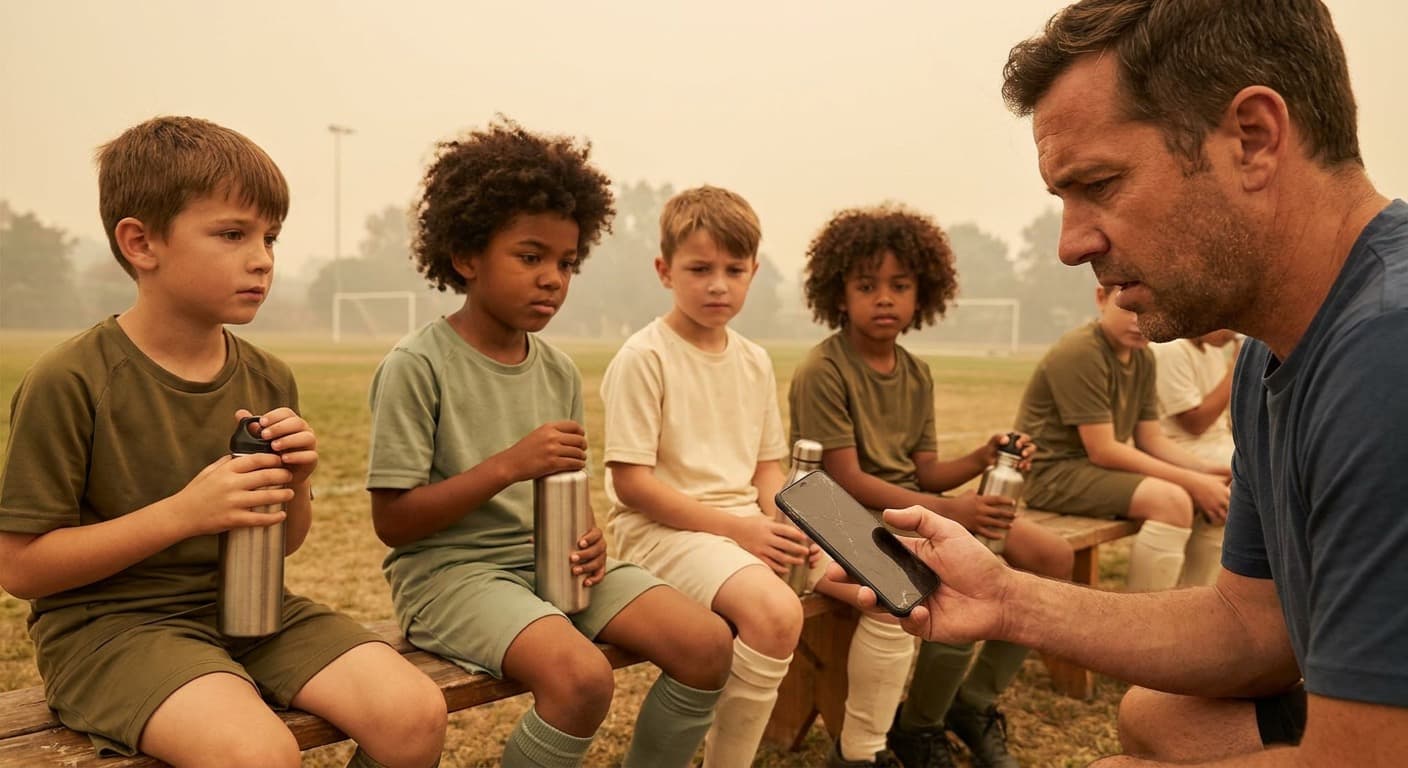
AQI 150 and Your Kid's Soccer Practice: A Parent's Decision Guide
AQI 150 sits at the boundary between "Unhealthy for Sensitive Groups" and "Unhealthy" — and children are a sensitive group. This guide maps EPA and AirNow activity guidance to the decisions parents actually face: play, shorten, move indoors, or reschedule.
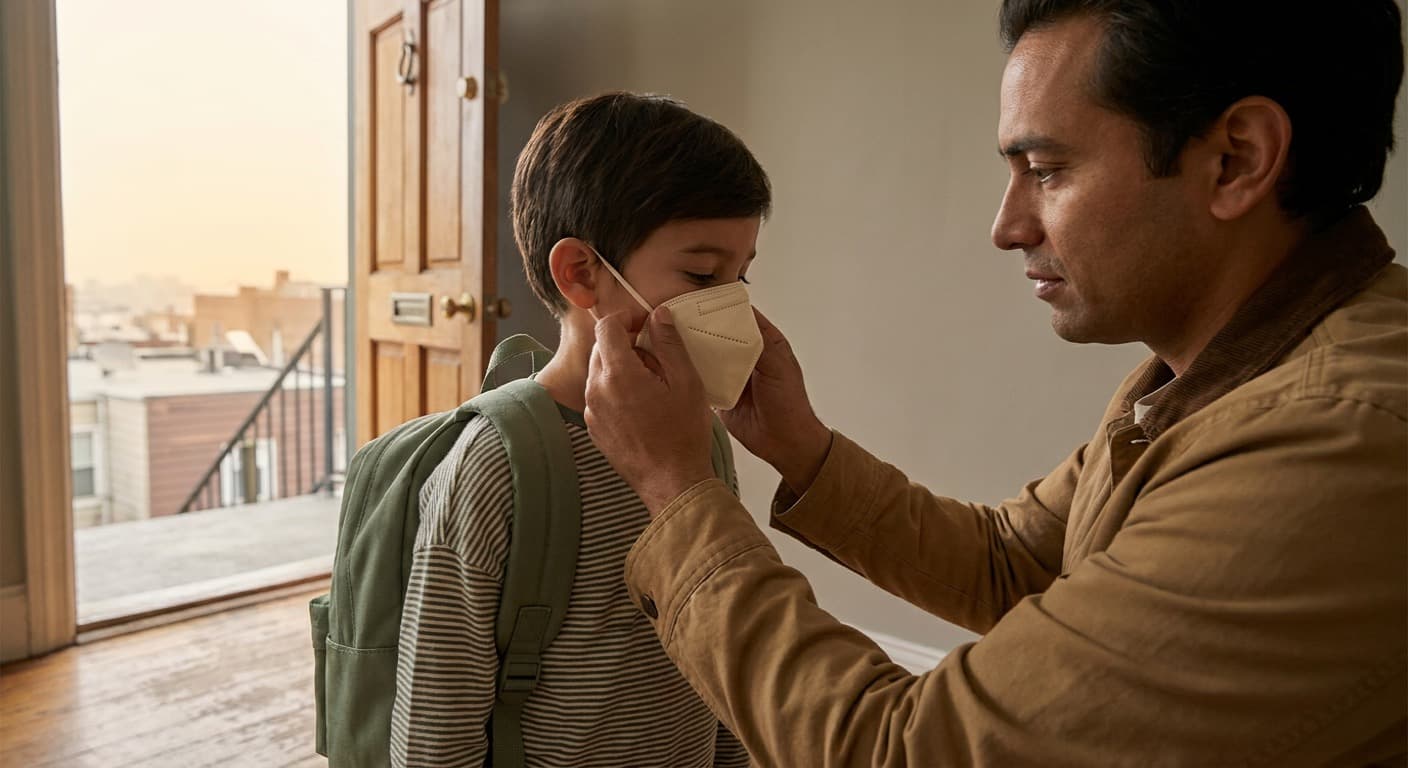
Why Age 7 Is the Dividing Line for Kids and Masks
EPA warns that respirators are not sized for young children — but pediatric environmental health specialists draw a practical line at age 7. Here is why fit fails on smaller faces, why older kids can often wear adult-small sizes, and what parents of younger children should do instead during wildfire smoke.

Luftqualität und Kinder: Ein umfassender Eltern-Leitfaden
Kinder atmen schneller, verbringen mehr Zeit draußen und haben sich entwickelnde Lungen — das macht sie besonders anfällig für Luftverschmutzung. Hier ist alles, was Eltern wissen müssen, um die Atemgesundheit ihrer Kinder zu schützen.