Why Your Glasses Fog With a Mask On (And What It Tells You)
Fogged glasses are not a glasses problem — they are evidence that warm breath is escaping through a gap at your nose bridge, which is the same gap letting unfiltered air in. Here is why the nose bridge fails on most masks, what the popular fixes actually do, and why anti-fog spray is the worst of them.
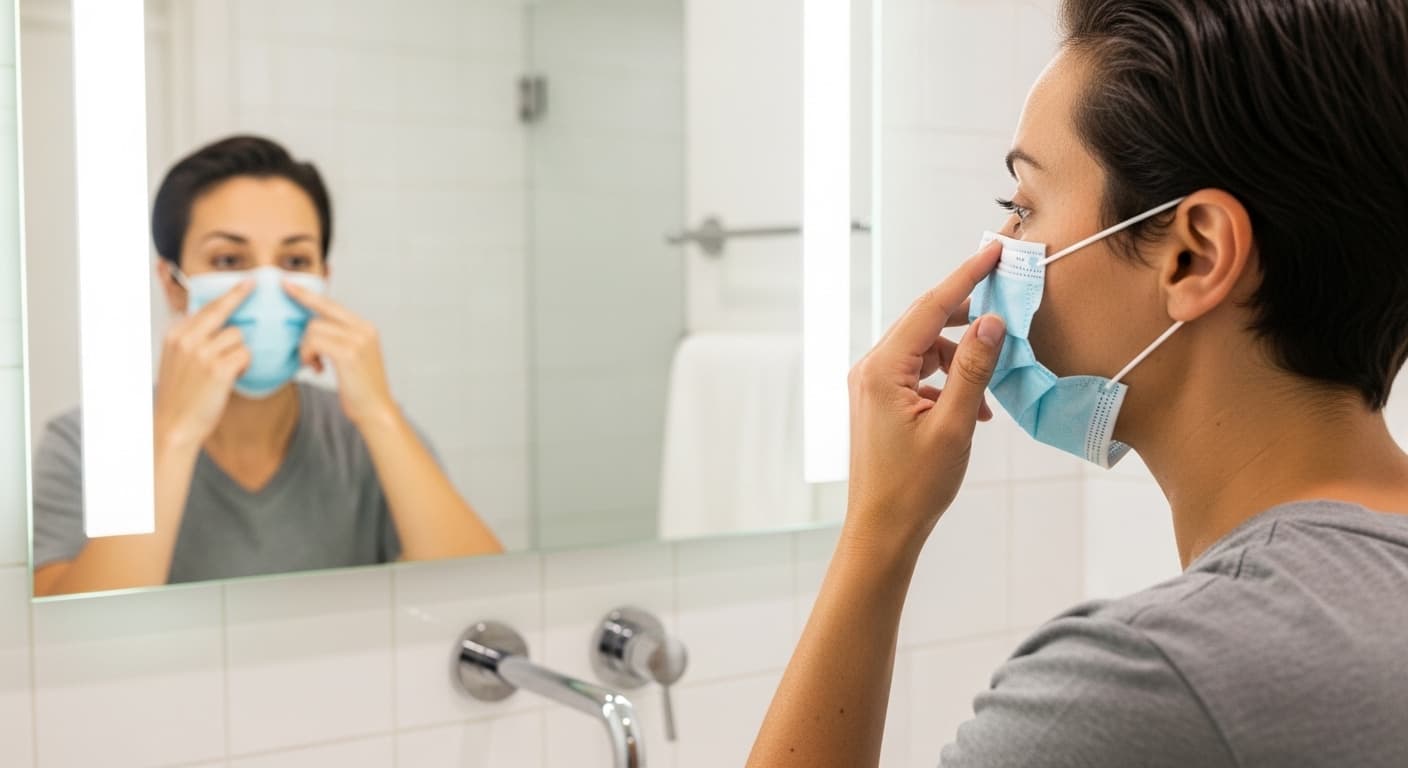
Fogged glasses are not really a glasses problem. They are a diagnostic. Warm, humid air from your breath is escaping upward through the gap between the mask and the bridge of your nose, hitting cooler lens glass, and condensing there. The fog is simply the visible evidence of air taking a route it was not supposed to take — and that same route is how unfiltered air gets in.
Which means the tape-and-tissue workarounds circulating online treat the symptom while leaving the cause in place. If you fix the seal, the fog goes away as a side effect. This piece covers why the nose bridge is where masks usually fail, what the common fixes actually do, and how to tell whether yours is sealing.
Fog on your lenses means air is bypassing the filter at the nose bridge. A mask rated to filter 95% of particles does not deliver that if a meaningful share of each breath travels around the edge instead of through the media. Treat fogging as free feedback about your seal.
Why Does the Nose Bridge Fail on Most Masks?
The bridge of the nose is the hardest part of the face to seal against. It is a sharp, narrow ridge with steep slopes on both sides and a hollow at each side where the nose meets the cheek. Flat-fold masks are cut from flat material, so covering that geometry means the material has to deform in two directions at once — and flat sheets do not do that well. The result is a small triangular gap on each side of the bridge.
Most masks address this with a bendable aluminum strip. It helps, but it is a single-axis solution to a two-axis problem: it can follow the ridge line while still leaving the side hollows open. It also fatigues. Every time the strip is bent, unbent, and rebent, it holds its shape slightly less well, which is why a mask that sealed properly in week one may not in week four.
Do the Common Fixes Actually Work?
Most of the popular advice does something, and it is worth being clear about what each one does and what it costs you.
| Fix | What it actually does | The catch |
|---|---|---|
| Folding a tissue over the nose bridge | Absorbs moisture and partially blocks the gap | Does not close the gap, and the tissue saturates. Air still bypasses the filter. |
| Taping the mask to your face | Genuinely closes the leak path | Skin irritation with repeat use, and it fails as soon as you talk or move much. |
| Anti-fog spray or soapy film on lenses | Stops condensation forming on the lens | Purely cosmetic. The leak is unchanged, so filtration is still compromised. |
| Wearing glasses on top of the mask edge | Physically blocks some upward airflow | Pushes the mask down, which can open the seal further at the cheeks. |
| Pinching the nose wire harder | Improves seal along the ridge | The most useful of the quick fixes, but does not address the side hollows. |
Notice the pattern. The anti-fog spray is the one that most reliably clears your vision and does the least for your protection — it removes the evidence while leaving the leak. That is the opposite of what you want from a mask you are wearing for a reason.
How Do You Tell Whether Your Mask Is Sealing?
You do not need equipment for this. Put the mask on, cover its surface with both hands, and inhale sharply. A sealing mask draws inward against your face and you feel resistance. If air slips in at the nose, cheeks or chin, or the mask barely moves, it is not sealing — and the filtration rating printed on the box is not what you are getting.
Glasses give you a second, continuous version of the same test. If they stay clear through a normal breathing cycle, the nose bridge is holding. If they fog when you exhale hard or talk, it is not.
Related Article
How to Test Your Mask Fit and Seal
The full set of checks, including what to do when a mask fails one.
What Does a Structural Fix Look Like?
The alternative to deforming a flat sheet is not to start with a flat sheet. AirPop's 3D AeroDome structure is built to hold an opening in front of the mouth and nose, with the sealing surface following facial contours rather than being pinched into shape at the point of wear. The nose bridge is part of that formed structure instead of a strip you re-bend each morning.
This is also why ASTM F3502-21 is the more informative certification to look for. Alongside filtration efficiency it tests leakage and breathing resistance, so a mask cannot pass on filtration alone while sealing poorly. A standard that measures leakage is measuring the thing that causes your glasses to fog.
Filtration efficiency describes the media. Fit determines how much of your breath actually meets it. AirPop masks are certified to ASTM F3502-21 (Intertek), which grades both filtration and breathability on the whole mask — and are engineered under 50 Pa of breathing resistance so the seal is not paid for in effort.
What Should You Do Right Now?
- 1Run the seal check described above before assuming the mask is the problem — a mask worn slightly low on the nose is a common and instant fix.
- 2Shape the nose wire with two fingers along the ridge and then press down into the hollow at each side, rather than pinching the top only.
- 3Check strap tension. Stretched straps let the whole mask sit loose, and no nose wire compensates for that.
- 4If your glasses still fog with the mask correctly positioned and the wire shaped, the mask does not fit your face. That is a sizing and geometry problem, not a technique problem.
- 5Skip the anti-fog spray unless you have already fixed the seal. Clearing the lens without closing the leak just removes your best warning signal.
Über den Autor
Jett FuCo-Founder & CEO, AirPop
Cross-border entrepreneur and co-founder of AirPop. Leads global operations, retail expansion across 35+ markets, and B2B distribution partnerships with Target, Amazon, and Best Buy.
See the Technology
3D AeroDome structure — how a formed mask seals differently from a flat-fold one.
See the TechnologyVerwandte Artikel

How Long Does a KN95 Mask Last? What Actually Wears Out
There is no expiry date on a KN95, and a depleted mask looks identical to a new one. What wears out is the electrostatic charge in the filter media, the seal against your face, and the straps — three things that fail at different rates. Here is what degrades, what certifications do not cover, and when to replace it.
N95 vs KN95: Which One Should You Actually Wear?
N95 and KN95 set the same filtration bar — at least 95% at the most-penetrating particle size. The difference is which country certified the mask, and far more consequentially, how it attaches to your head. Headbands pull evenly from behind; ear loops pull from two side points and are more prone to gapping. Here is what separates the two standards, how to spot a counterfeit KN95, and where ASTM F3502-21 fits.

Do Face Masks Expire? What the Date on the Box Actually Means
The date printed on a box of N95, KN95 or surgical masks is a manufacturer shelf-life date, not a safety cliff. What ages in storage is mostly mechanical — elastic straps lose tension, nose foam takes a set, packaging integrity fails — and all of it is checkable by hand. The one thing you cannot check is the electrostatic charge. Here is what degrades, how to test a stored mask, and how reusable masks run on a different clock entirely.