
Running in Cold Weather With a Mask: What Actually Happens
Cold-weather running creates one specific problem for masks, and everything else follows from it: condensation. Warm saturated breath meets fabric sitting at outdoor temperature, the vapour condenses, and unlike in summer it does not evaporate between breaths. A wet mask breathes harder and filters worse — one of which you notice immediately, one of which you never notice at all. Here is the physics, and what to look for.
Running in cold weather with a mask creates one specific problem, and almost everything else follows from it: condensation. Your exhaled breath is warm and close to fully saturated with water vapor. When it hits fabric that is sitting at outdoor temperature, that vapor condenses on the inside of the mask. In summer most of it evaporates away between breaths. Below freezing it does not — it accumulates, and within a few kilometers the mask is wet.
A wet mask is a different product from a dry one. It breathes harder, it sits against your lips, and if it relies on electrostatic filtration it is losing the mechanism that does the filtering. Here is what actually happens, and what to look for in a mask you intend to run in.
Why Does a Mask Get Wet When You Run in the Cold?
Three things compound. Exercise raises your breathing rate and volume, so you are moving far more air — and far more water vapor — through the mask than you would walking. Cold air holds much less moisture than warm air, so the vapor in your breath reaches its dew point almost immediately on contact with the cold fabric. And the mask itself, chilled from the outside by wind, stays cold enough that the condensed water never gets a chance to evaporate.
The result is a mask that gets progressively damper the longer and harder you run, in a way that has no summer equivalent. Runners often describe it as the mask "collapsing" onto the face — which is exactly what a saturated flat-fold does.
KN95, N95 and most disposable masks filter using an electrostatic charge held in meltblown polypropylene. Moisture degrades that charge, and it gives no visual signal when it does. A damp mask that looks fine is the exact failure mode described in our guide to what wears out in a KN95.
Does a Wet Mask Still Work?
Two things degrade at once, and they pull in opposite directions in terms of how obvious they are.
- Breathing resistance rises, and you will notice this immediately. Water in the media blocks airflow paths, so the same breath takes more effort. This is the part runners complain about.
- Filtration efficiency falls, and you will not notice this at all. Charge loss is invisible, odorless, and produces no change in how the mask looks or feels.
The practical consequence is that the discomfort arrives before the performance loss becomes relevant to you, which is a reasonable warning system as long as you act on it. If a mask has become noticeably harder to breathe through on a cold run, that is the point to swap it rather than push on.
Why Do My Glasses Fog Up More in Winter?
Fogging is a seal problem wearing a disguise. Warm, humid breath escapes upward through the gap between the mask and the bridge of your nose, hits a cold lens, and condenses. In winter the temperature difference between your breath and the lens is at its largest, so the same size gap produces dramatically more fog than it would in spring.
Which means fogged lenses are useful information: they are telling you where your mask is leaking. The remedies that work are the ones that close the gap — a nose wire that actually conforms to your bridge rather than a token strip of aluminum, and foam or a structured edge that fills the hollows either side of the nose. Every workaround that does not close the gap (tissue stuffed under the edge, anti-fog sprays on the lens) is treating the symptom.
Why Mask Shape Matters More in Winter Than in Summer
A flat-fold mask has no internal structure. Dry, it holds its shape well enough. Wet, it has nothing resisting the suction of a hard inhale, so it pulls flat against the mouth — and once fabric is against your lips it stays wet, blocks airflow across its whole surface, and is genuinely unpleasant to breathe through.
A formed mask holds an air space in front of the mouth and nose. That space does two useful things in the cold: it keeps wet fabric off your lips, and it gives the condensed moisture somewhere to sit other than directly in the airflow path. AirPop's 3D AeroDome structure is built around exactly this — a shaped chamber that does not collapse under a hard inhale, which is a design constraint that only becomes obvious when you are breathing hard in cold air.
Everything above is about how a mask behaves physically in cold conditions — condensation, breathing resistance, seal, and shape. It is not a claim that wearing a mask treats, prevents, or improves any medical condition related to cold-weather exercise. If cold air affects your breathing in ways that concern you, that is a conversation for a clinician, not a product page.
What Should You Look For in a Cold-Weather Mask?
- A structured shape that holds an air gap and does not collapse when you inhale hard
- A nose wire with enough stiffness to take and hold the shape of your bridge — the difference between fogged lenses and clear ones
- Breathability that is actually measured. ASTM F3502-21 reports breathing resistance alongside filtration, which is the pairing that matters when you are working hard
- Straps that stay put through movement, since a mask that shifts every few strides will not seal
- A design you can carry a spare of, because on a long cold run the realistic plan is to swap rather than to find a mask that never gets damp
That last point is worth stating plainly, because no mask solves condensation outright. Warm wet air meeting cold fabric will always condense. What a good cold-weather mask does is delay the point at which it matters and keep the wet fabric off your face when it happens.
What About Neck Gaiters and Balaclavas?
They are a different product solving a different problem. A gaiter or balaclava is designed for warmth and wind protection, and most are a single layer of stretch knit with no filter media and no certification behind them. They are good at what they are for, and they are not respiratory protection — there is no filtration rating to check, and the loose fit that makes them comfortable is the opposite of a seal.
If your reason for covering your face on a winter run is wind and warmth, a gaiter is a sensible choice. If your reason is air quality — a winter inversion trapping traffic emissions, or smoke lingering in the valley — then you need something with a filtration standard printed on it, and the two jobs are worth separating rather than hoping one product does both.
Related Article
How Long Does a KN95 Mask Last?
Why moisture is the fastest route to filter failure, and why it is invisible.
Related Article
How to Test Your Mask Fit and Seal
The five-second check that tells you whether the nose bridge is doing its job.
Related Article
When Does Flu Season Actually Start? 29 Seasons of CDC Data
Cold-weather running season and flu season overlap almost exactly. Here is the 29-year timing record.
著者について
Jett FuCo-Founder & CEO, AirPop
Cross-border entrepreneur and co-founder of AirPop. Leads global operations, retail expansion across 35+ markets, and B2B distribution partnerships with Target, Amazon, and Best Buy.
See the Technology
3D AeroDome structure — how a formed mask holds its shape under a hard inhale.
See the Technology関連記事

How Long Does a KN95 Mask Last? What Actually Wears Out
There is no expiry date on a KN95, and a depleted mask looks identical to a new one. What wears out is the electrostatic charge in the filter media, the seal against your face, and the straps — three things that fail at different rates. Here is what degrades, what certifications do not cover, and when to replace it.

Do Face Masks Expire? What the Date on the Box Actually Means
The date printed on a box of N95, KN95 or surgical masks is a manufacturer shelf-life date, not a safety cliff. What ages in storage is mostly mechanical — elastic straps lose tension, nose foam takes a set, packaging integrity fails — and all of it is checkable by hand. The one thing you cannot check is the electrostatic charge. Here is what degrades, how to test a stored mask, and how reusable masks run on a different clock entirely.
Why Your Glasses Fog With a Mask On (And What It Tells You)
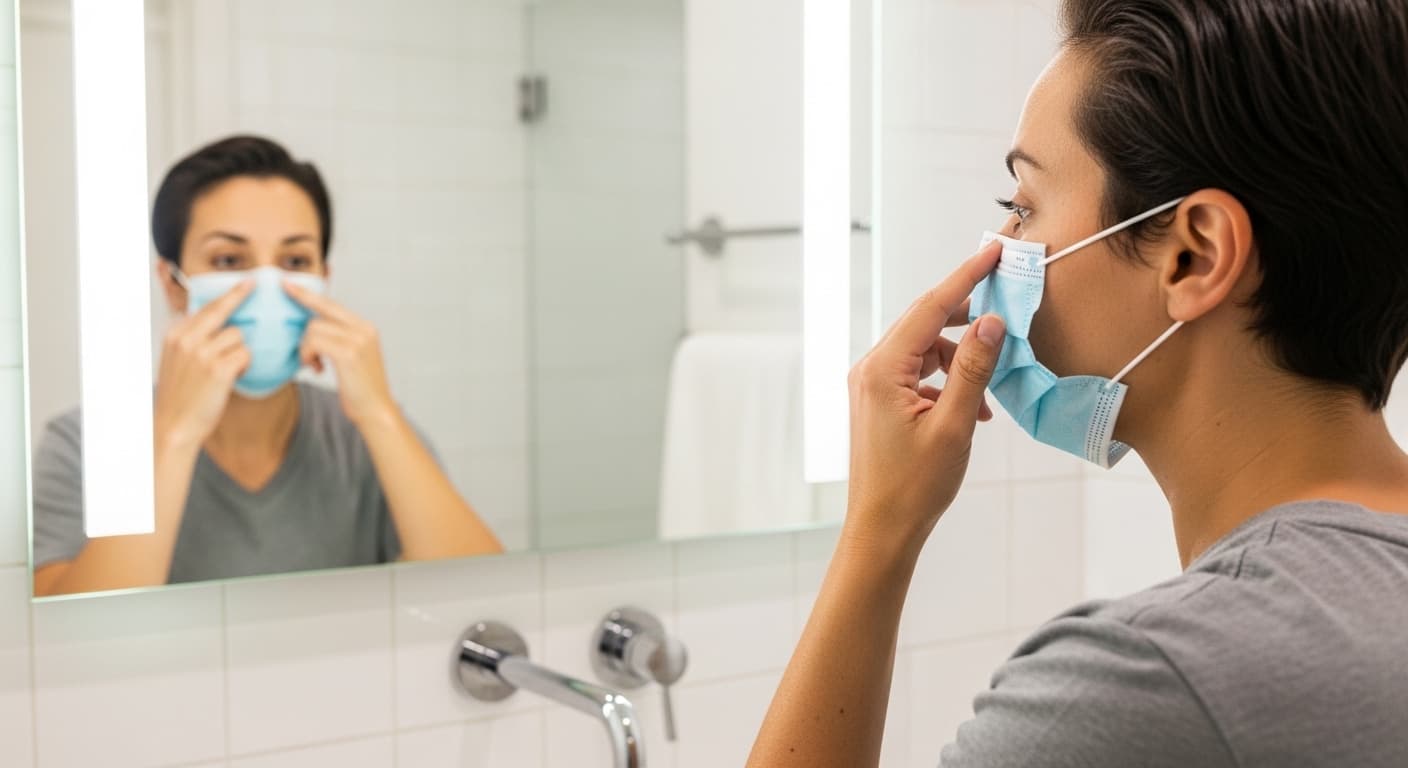
Fogged glasses are not a glasses problem — they are evidence that warm breath is escaping through a gap at your nose bridge, which is the same gap letting unfiltered air in. Here is why the nose bridge fails on most masks, what the popular fixes actually do, and why anti-fog spray is the worst of them.