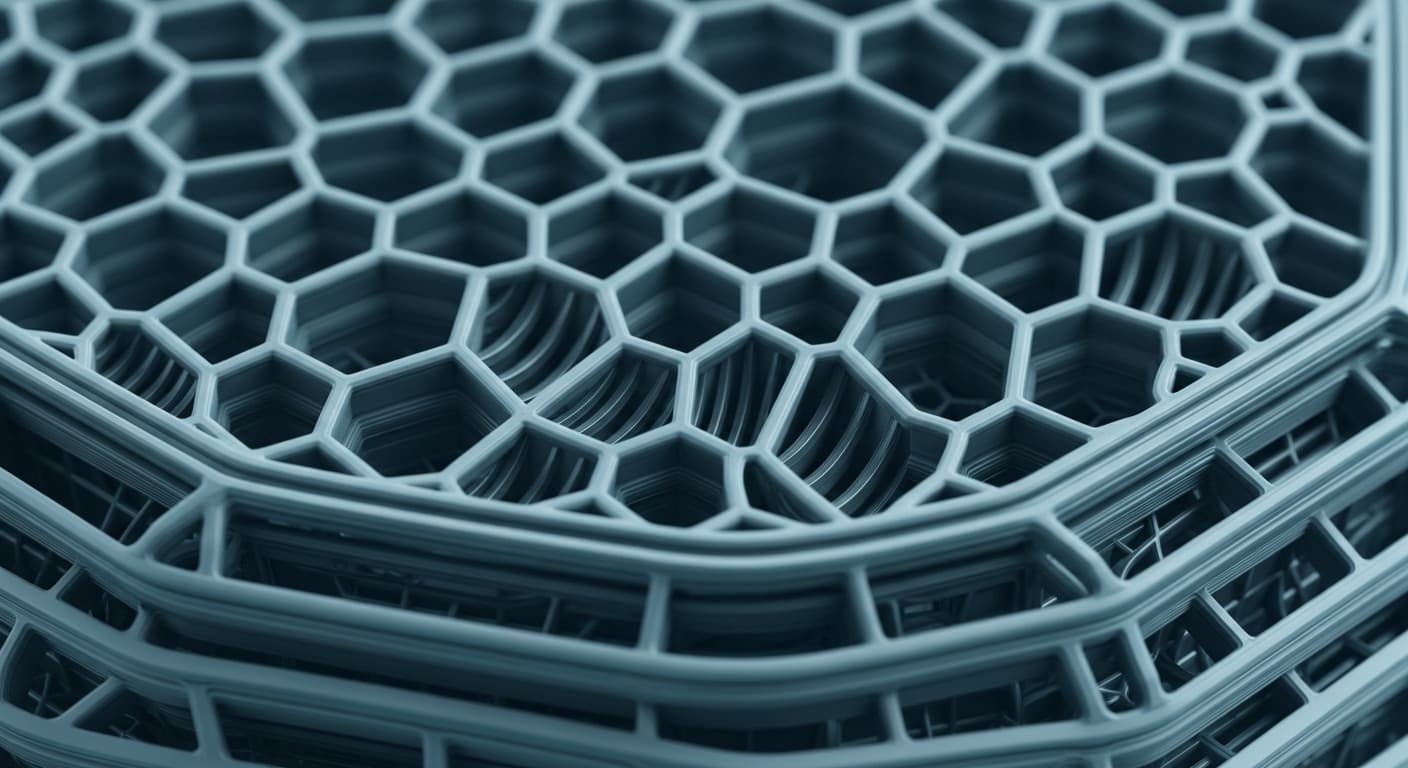
Inside AirPop's 3D AeroDome: The Engineering Behind Better Breathing
AirPop's patented 3D AeroDome structure creates a breathing chamber that separates the filter from your face — improving airflow, comfort, and filtration simultaneously. Here is the engineering deep dive.
Every mask filters. The question is what happens to the air between the filter and your face. Traditional flat-fold masks press fabric directly against your mouth and nose, collapsing with each inhale and expanding with each exhale. This creates turbulence, increases breathing resistance, and forces air through a constantly shifting seal perimeter. The AirPop 3D AeroDome was engineered to solve this fundamental problem — by creating architecture where other masks have only fabric.
The 3D AeroDome is not a marketing feature. It is the core engineering principle behind every AirPop product: create a structural breathing chamber that separates filtration from respiration. The result is a mask that works like a building, with walls, airspace, and engineered airflow, rather than a piece of cloth pressed against your face.
Why Did AirPop Invent the 3D AeroDome?
In 2015, AirPop founder Chris Hosmer was living in Shanghai during some of the worst air quality events in modern history. PM2.5 readings regularly exceeded 300 μg/m³, more than 12 times the WHO guideline. The masks available were either industrial respirators designed for construction workers or flimsy surgical-style coverings that offered almost no particle protection. Hosmer, a product designer by training, saw a fundamental design failure: no one had applied consumer product engineering to respiratory protection.
“I kept asking the same question: why does every mask fight against the person wearing it? The filter wants to work. Your lungs want to breathe. The problem is the space, or lack of space — between them. That is what we set out to solve.”
— Chris Hosmer, Founder & CEO, AirPop
How the Breathing Chamber Works
The AeroDome creates a structured internal volume, a breathing chamber — between the filter media and the wearer's face. This is achieved through a combination of engineered support structures, material rigidity calibration, and geometric design that maintains shape under negative pressure (inhalation) and positive pressure (exhalation). The chamber serves three critical functions: it increases the effective filtration surface area, reduces air velocity through the filter, and prevents the filter from collapsing against the face.
Airflow Dynamics: The Physics of Breathing
When you inhale through a flat mask, air velocity concentrates at the point of least resistance, typically around the nose and edges where the fabric sits closest to the face. This creates localized high-velocity zones where filtration efficiency drops (particles have less contact time with filter fibers) and seal integrity is compromised (negative pressure pulls the mask away from the face at the edges). The AeroDome distributes airflow across a much larger surface area. By maintaining consistent standoff distance between the filter and the face, air passes through the filter at lower velocity and more uniform distribution — both of which increase effective filtration.
Filtration efficiency is inversely related to air velocity through the filter. At lower velocities, particles spend more time in contact with filter fibers, increasing the probability of capture through diffusion, interception, and inertial impaction. The AeroDome's expanded surface area reduces face velocity by approximately 40%, which measurably improves real-world filtration performance.
The 360° Seal System
Filtration without seal is theater. A mask can filter 99.9% of particles, but if 30% of inhaled air bypasses the filter through gaps, real-world protection drops dramatically. The AeroDome's 3D structure enables a continuous 360-degree seal around the entire face perimeter, from the bridge of the nose, across the cheeks, under the chin, and back up. Unlike flat masks that rely on a single nose wire and friction to stay sealed, the AeroDome's geometry creates consistent inward pressure at every contact point. The dual-strap adjustment system allows independent tension control for upper and lower face, accommodating the wide range of facial geometries that flat masks simply cannot address.
Material Science Behind the Structure
The AeroDome's structural integrity comes from a proprietary multi-layer construction. The outer layer provides structural rigidity and environmental protection. The core filtration layer uses electrostatically charged melt-blown polypropylene to capture particles as small as 0.1 microns. The inner layer is engineered for skin comfort and moisture management. The total construction weighs just 4.5 grams while maintaining shape through thousands of breathing cycles, a balance of rigidity and flexibility that required over 2,000 hours of wear testing across 7 complete design revisions.
Seven Generations of Design Iteration
The current AirPop Light SE represents the seventh major revision of the AeroDome concept. Each generation addressed specific performance gaps identified through lab testing and real-world wear studies. Early prototypes maintained structure but were too rigid for comfortable all-day wear. Subsequent versions reduced weight but sacrificed seal integrity at the chin. The breakthrough came in generation five, when the team discovered that graduated rigidity — stiffer at the bridge and chin, more flexible at the cheeks — could maintain structural integrity while conforming to facial movement during speech and expression.
“We tested every generation on real people doing real things — talking, eating, commuting, exercising. A mask that works perfectly in a lab but fails on a subway platform is not a solution. The AeroDome had to work in life, not just in testing chambers.”
— Chris Hosmer, Founder & CEO, AirPop
How AeroDome Compares to Traditional Designs
- Flat-fold masks: Collapse on inhale, reducing filtration surface area by 40-60% — AeroDome maintains consistent volume
- Cup-style respirators (N95): Rigid but bulky with single-point nose seal — AeroDome achieves similar protection at one-third the weight
- Surgical ear-loop masks: No seal mechanism at all — studies show 40-60% of air bypasses the filter entirely
- KN95 folding masks: Better than flat but still compress under breathing — AeroDome's engineered structure prevents collapse
- Valve-equipped masks: Reduce exhalation resistance but release unfiltered air outward — AeroDome achieves low breathing resistance without compromising source control
Put on any flat mask and take a deep breath. Feel the fabric pull against your face? That is resistance your lungs are fighting with every breath. Now imagine 8 hours of that. The AeroDome eliminates this collapse effect entirely. You breathe into a chamber, not against a wall.
Related Article
The Science of Filtration
How electrostatically charged melt-blown media captures particles at the sub-micron level.
Related Article
AirPop Light SE vs. Standard Flat-Fold Masks
A detailed performance comparison between 3D-engineered and traditional mask designs.
About the author
Chris HosmerCo-Founder, AirPop
Industrial designer and co-founder of AirPop. In 2015, while living in Shanghai, he invented AirPop's first smart mask after watching his own children struggle to breathe through the city's air pollution — creating the Air Wearables category. Leads product engineering, certification testing, and filtration technology development.
See the Technology
Patents, certifications, and the science behind every AirPop product.
See the TechnologyRelated Articles
The Science of Filtration: How AirPop Blocks >97% of Particles
Electrostatic capture, mechanical interception, and multi-layer media engineering — discover the science that allows AirPop masks to filter out >97% of airborne particles while remaining remarkably breathable.

How Masks Are Tested: The Science Behind Certification Standards
From salt aerosol generators to breathing simulators — a behind-the-scenes look at how laboratories test masks for filtration, breathability, and real-world fit, with a side-by-side comparison of the N95, KN95, KF94, FFP2, and ASTM F3502-21 standards.

The Complete Guide to ASTM F3502-21: What This Certification Really Means
ASTM F3502-21 is the only US standard that tests both filtration AND fit for consumer masks. This guide explains what it measures, why other certifications fall short, and how to verify that your mask actually protects you.