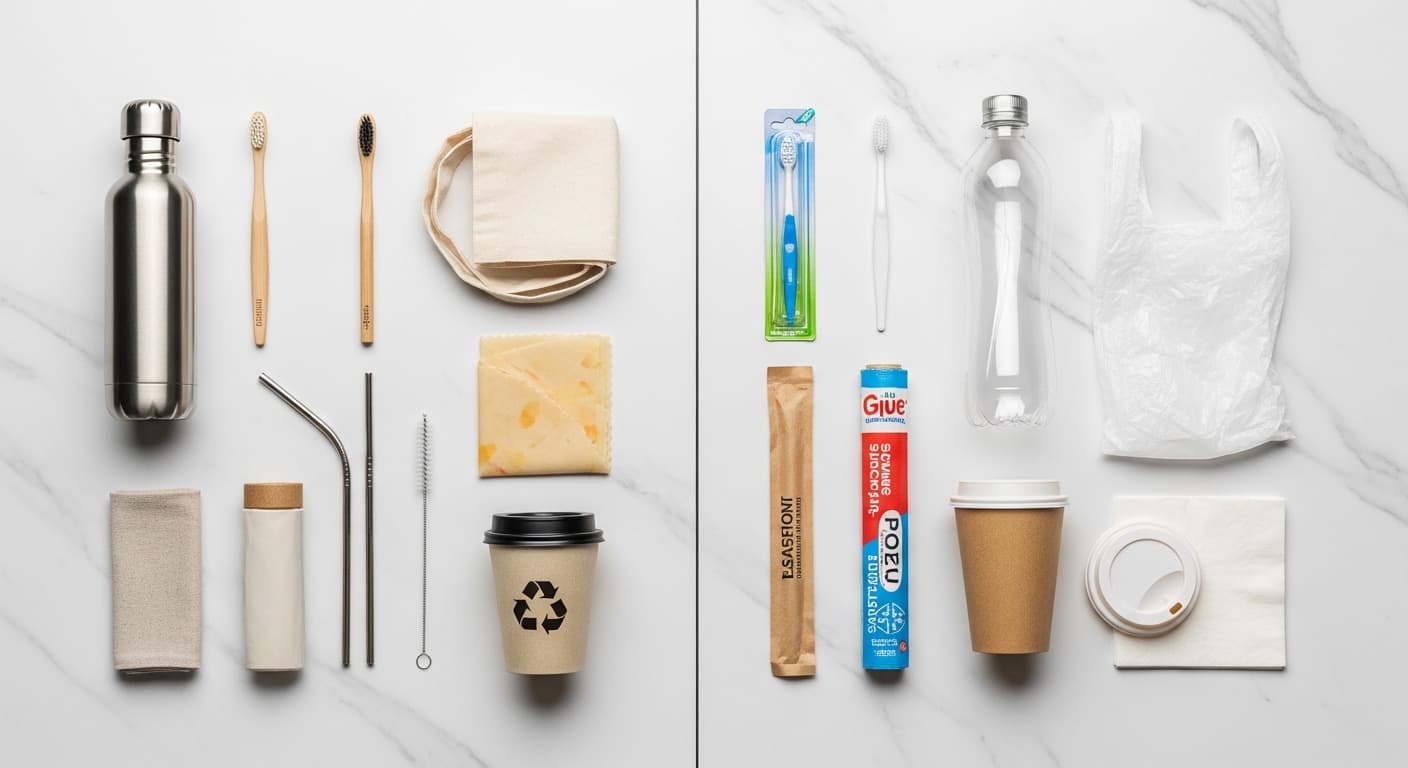
Reusable vs Disposable Masks in 2026: The Complete Comparison
Reusable masks now match N95 filtration at under $2 per use — saving families $120+ per flu season. Full 2026 data on cost, performance, and why 129 billion disposable masks per month is unsustainable.
For years, the default assumption was that disposable masks, particularly N95 respirators — were the gold standard for respiratory protection. Reusable alternatives were viewed as a compromise: eco-friendly, perhaps, but less effective. In 2026, that assumption no longer holds. Advances in materials science, 3D structural engineering, and electrostatic filtration have produced reusable masks that match or exceed disposable N95s in filtration efficiency, fit, and breathability, while costing a fraction per use and eliminating the environmental waste of single-use products.
Are Reusable Masks Worth It?
Yes, if you wear a mask more than occasionally — and the break-even is lower than most people assume. A four-pack of AirPop Light SE is $19.99 and delivers 40 wears, so it costs about $0.50 per wear no matter how often you reach for it. A certified disposable typically runs $0.50 to $2.00 and lasts one wear. That means reusable protection pays off against anything but the very cheapest single-use mask, and the gap widens the more days you actually wear one. If you mask a handful of times a year, a box of disposables is genuinely simpler and the money barely moves. If you commute, work outdoors, live somewhere with a wildfire or allergy season, or mask through the winter, reusable is the cheaper option and the less wasteful one.
Reusable wins on cost above roughly $0.50 per disposable mask, wins on waste at any volume, and is at least equal on protection — a 2025 PLOS ONE fit study passed a structured reusable mask on 21 of 22 subjects. It loses only on convenience: you have to wash it, and you have to replace it when the seal degrades rather than when the box runs out.
Filtration Performance: Can Reusable Masks Actually Match Disposables?
The most critical question for any mask is filtration efficiency, how effectively it blocks airborne particles. Standard surgical masks typically filter 60-80% of particles at 0.3 microns (PM0.3), the most penetrating particle size. Disposable N95 respirators are certified to filter at least 95% at this size. But premium reusable masks have now surpassed both categories.
AirPop masks, for example, achieve >97% particle filtration efficiency at PM0.3, independently verified by accredited labs including Intertek, SGS, and BSI. This exceeds the N95 standard by a significant margin, and the performance is maintained through multiple cleaning cycles thanks to the multi-layer electrostatic filter media that is the core of the filtration system.
AirPop reusable masks maintain their filtration performance through 10 cleaning cycles (70% alcohol wipe, Intertek). The wipe-clean outer shell protects the inner electrostatic filter layer, and the 3D Aerodome structure prevents the filter from collapsing, a common failure point in flat-fold disposables that get damp or crushed.
A 2021 study published in PLOS ONE tested the protective performance of reusable cloth masks, disposable procedure masks, KN95 masks, and N95 respirators. The study found that total inward leakage, the real-world measure of protection that accounts for both filtration and fit — varied enormously. Many disposable KN95 and surgical masks leaked significantly around the edges, undermining their filtration performance. Structured reusable masks with proper seals performed comparably to N95 respirators in total inward leakage tests.
Fit and Seal: Where Disposables Fall Short
A mask that filters 97% of particles but leaks around the edges does not actually provide 97% protection. This is the critical weakness of flat-fold disposable masks. Without a structured seal system, air takes the path of least resistance, around the mask rather than through it. Studies consistently show that fit is as important as filtration in real-world protection.
There is direct evidence that a reusable design can seal to occupational standards. A 2025 PLOS ONE study put a structured reusable mask through OSHA-accepted quantitative fit testing on 22 subjects; 21 passed, with the single failure attributed to sizing. Two caveats belong with that number rather than in a footnote. The mask tested was the Altus Hero, not an AirPop, and the study did not fit-test the N95 it was compared against on other measures — so it establishes that reusables can pass, not that they outperform. It was also funded by the mask manufacturer, which is disclosed in the paper and is worth knowing. What it does settle is the assumption this article opened with: nothing about being reusable makes a mask seal worse.
AirPop addresses this with a patented 360° Soft Touch Seal that conforms to the wearer's face, eliminating the gaps common in flat-fold masks. Combined with the 3D Aerodome structure that maintains its shape during breathing, the result is a consistent seal that does not depend on the user perfectly pinching a nose wire or adjusting ear loops, the two most common failure points in disposable mask fit.
Breathability and Comfort: The Compliance Factor
The best mask in the world provides zero protection if you take it off because it is uncomfortable. This is the compliance factor, and it is where reusable masks are pulling decisively ahead of disposables in 2026.
Standard N95 respirators create significant breathing resistance, heat buildup, and moisture accumulation. The 2025 PLOS ONE study found that a structured reusable mask showed significantly reduced heat retention compared to the disposable N95 (p<0.05), with users reporting the reusable mask felt cooler. Blood oxygen levels showed no significant difference between the two, meaning the reusable mask was more comfortable without any reduction in breathability.
AirPop's 3D Aerodome structure creates an air pocket between the mask and the wearer's face. This engineering approach allows 2x the airflow compared to standard N95 masks, which means less heat buildup, less moisture, and easier breathing and speaking. For anyone wearing a mask for hours at a time — commuters, travelers, office workers, or anyone during flu season. This difference is not marginal. It is the difference between wearing the mask and pocketing it.
“Despite needing design refinements, most subjects preferred the reusable mask for comfort and usability.”
— PLOS ONE, April 2025 — Fit, heat stress, and comfort study
Cost Comparison: Reusable vs Disposable Over Time
The per-unit price of a disposable mask is lower, but per wear is the number that decides this. A disposable N95 or KN95 costs $0.50-$2.00 and is meant for a single use — once worn, it goes in the bin. An AirPop Light SE four-pack retails at $19.99, and each mask is reusable for up to 10 cleaning cycles, so the pack delivers 40 wears. That works out to about $0.50 per wear, flat, and it is the same arithmetic our cost-per-wear calculator runs if you want to put your own numbers in.
Here is that in practice. A family of four wearing a mask every day through a 20-week season needs about 560 wears. Disposables at $0.75 each — a typical retail price for a certified KN95 — come to $420. The same 560 wears in AirPop Light SE means 14 four-packs, or $280. The saving is roughly $140 for the season, and it scales with how much you would otherwise be paying per disposable: at $2.00 a mask the gap is over $800, and at $0.50 a mask there is no gap at all. That last case is the honest boundary of this argument. Reusable protection wins on cost whenever a single-use mask would cost you more than about fifty cents, and simply ties when it would not.
Environmental Impact: The Hidden Cost of Disposable Masks
The environmental toll of disposable masks is staggering. At the peak of global mask usage, an estimated 129 billion face masks were used every month worldwide. According to environmental researchers, an estimated 1.56 billion masks entered the ocean in 2020 alone, contributing between 4,680 and 6,240 metric tons of marine plastic pollution.
Disposable masks are made primarily of polypropylene and polyethylene, synthetic polymers that take 400 to 450 years to decompose in the environment. As they break down, they do not disappear. They fragment into microplastics, releasing microparticles and metal ions into soil and water systems. A single disposable mask can generate millions of microplastic particles during degradation.
The United Nations is actively negotiating a legally binding global plastics treaty (INC-5), with over 100 countries calling for caps on single-use plastic production. While the negotiations continue into 2026, the direction is clear: regulatory pressure on single-use plastics, including disposable PPE — is increasing worldwide.
Each AirPop mask is reusable for up to 10 cleaning cycles, so a four-pack displaces 40 single-use masks. For a family of four, that is 40 fewer disposable masks entering the waste stream per pack bought. Over a year of regular use, a single household can prevent hundreds of disposable masks from reaching landfills or the ocean.
Related Article
AirPop Light SE vs. Standard Flat-Fold Masks
See how a premium reusable compares head-to-head with traditional designs.
Certification: The Quality Benchmark That Matters
Not all masks — reusable or disposable — are created equal. The critical differentiator is third-party certification. Many budget masks make filtration claims that fail independent testing. When the CDC tested budget masks from various manufacturers, approximately 60% failed to meet their stated filtration claims.
ASTM F3502-21 is the US standard for barrier face coverings, and it is uniquely rigorous because it tests both filtration and fit, not just how well the material filters particles, but how well the mask actually seals to the face. AirPop is certified to ASTM F3502-21 by Intertek: Level 2 for filtration efficiency, Level 1 for air flow resistance.
- ASTM F3502-21 (Intertek): filtration efficiency and air flow resistance graded on the whole mask
- KN95 (GB2626-2019): Meets the Chinese respiratory protection standard
- AFNOR SPEC S76-001: Type-tested by BSI as a barrier mask (UK/EU)
- AirPop is certified to ASTM F3502-21 (Intertek) and tested to KN95 (GB 2626-2019, SGS) and AFNOR SPEC S76-001 (BSI type test)
The Full Comparison: Reusable vs Disposable at a Glance
| Metric | Premium Reusable | Disposable N95 | Surgical Mask |
|---|---|---|---|
| Filtration efficiency | >97% PM0.3 | >95% PM0.3 | 60-80% |
| Fit and seal | 360° engineered seal, consistent | Flat-fold, user-dependent, degrades | No seal, gaps on all sides |
| Breathability | 3D structure, 2x airflow vs N95 | High resistance, heat buildup | Low resistance, no seal |
| Cost per wear | $0.50 ($19.99 four-pack ÷ 40 wears) | $0.50-2.00 single use | $0.10-0.30 single use |
| 20-week season, family of 4 (560 wears) | $280 | $420 at $0.75 each | $56-168 |
| Environmental impact | One four-pack displaces 40 single-use masks | 450 years to decompose | Microplastic pollution |
| Comfort for extended wear | Designed for all-day use | Heat, moisture, pressure points | Loose, low pressure |
| Certification | ASTM F3502-21 (Intertek) | NIOSH N95 | Varies (often none) |
Market Trends: Consumers Are Making the Switch
The global anti-pollution face mask market reached $11.56 billion in 2025 and is projected to grow to $27.79 billion by 2035, at a compound annual growth rate of 9.17%. Within this market, the reusable segment captured approximately 40% of total revenue in 2026, roughly $5.05 billion, driven by sustainability trends, higher perceived value, and growing consumer preference for premium, performance-oriented products.
The demand drivers are structural and year-round: wildfire seasons are growing longer and more intense, the 2025-2026 flu season was the worst in 25 years, 81 million Americans suffer from seasonal allergies, and urban air quality continues to decline in major cities worldwide. These are not one-time events. They represent a permanent shift in consumer awareness about air quality and respiratory protection.
Who Should Choose Reusable?
Reusable respiratory protection makes sense for anyone who wears a mask regularly — which, given the air quality landscape of 2026, includes more people than ever:
- Daily commuters exposed to traffic pollution and crowded transit
- Allergy sufferers during pollen seasons (March-June, September-November)
- Wildfire smoke protection (increasingly year-round in the western US)
- Frequent travelers and business flyers
- Parents protecting children during flu season
- Exercise enthusiasts who train outdoors in variable air quality
- Anyone who values comfort for extended wear
- Environmentally conscious consumers reducing single-use waste
AirPop Air Wearables combine >97% filtration efficiency, patented 360° seal technology, and 2x the breathability of standard N95 masks, certified to ASTM F3502-21 (Intertek). Reusable for up to 10 cleaning cycles. Available at Target, Amazon, and 200+ retail partners worldwide.
Related Article
The Science of Filtration
How reusable masks now match N95-level filtration performance.
About the author
Chris HosmerCo-Founder, AirPop
Industrial designer and co-founder of AirPop. In 2015, while living in Shanghai, he invented AirPop's first smart mask after watching his own children struggle to breathe through the city's air pollution — creating the Air Wearables category. Leads product engineering, certification testing, and filtration technology development.
See AirPop Technology
Reusable respiratory protection with >97% filtration and 2x breathability.
See AirPop TechnologyRelated Articles

Best Masks for Wildfire Smoke in 2026: A Complete Buying Guide
Wildfire PM2.5 is 10x more harmful than urban pollution (Nature Communications). This guide ranks which masks actually filter the 200+ toxic compounds in wildfire smoke — and which fall short.

N95 vs KN95: Which One Should You Actually Wear?
N95 and KN95 set the same filtration bar — at least 95% at the most-penetrating particle size. The difference is which country certified the mask, and far more consequentially, how it attaches to your head. Headbands pull evenly from behind; ear loops pull from two side points and are more prone to gapping. Here is what separates the two standards, how to spot a counterfeit KN95, and where ASTM F3502-21 fits.
AirPop Light SE vs. Standard Flat-Fold Masks: A Head-to-Head Comparison
Not all respiratory protection masks are created equal. We put the AirPop Light SE side by side with a standard flat-fold mask to compare fit, breathability, filtration, and everyday wearability.