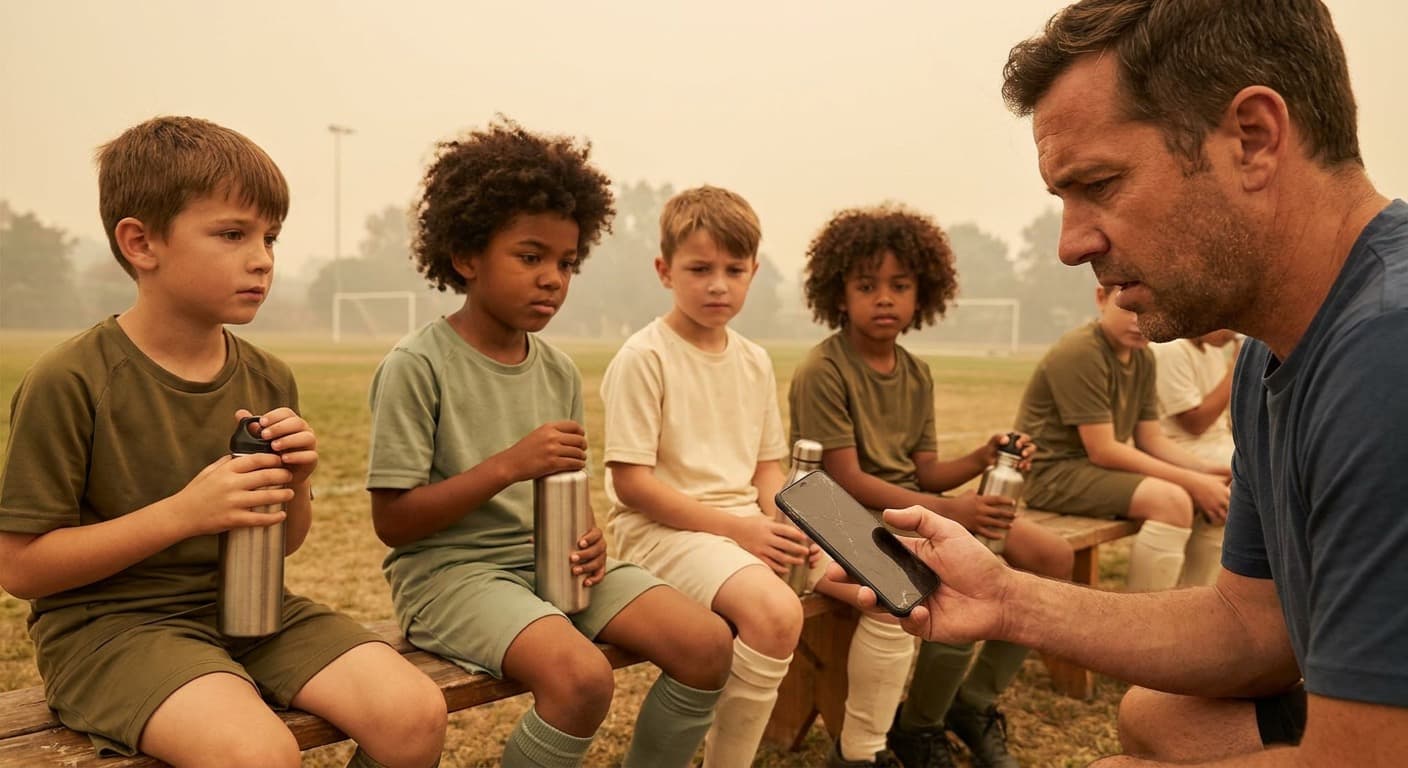
AQI 150 and Your Kid's Soccer Practice: A Parent's Decision Guide
AQI 150 sits at the boundary between "Unhealthy for Sensitive Groups" and "Unhealthy" — and children are a sensitive group. This guide maps EPA and AirNow activity guidance to the decisions parents actually face: play, shorten, move indoors, or reschedule.
It's 4:30 on a smoky afternoon. Soccer practice starts at 5:30, the league hasn't sent a cancellation email, and your weather app shows an AQI of 152. Do you send your kid? This guide translates the official EPA and AirNow activity guidance into a practical decision framework for exactly this moment — so you're deciding from numbers, not from how hazy the sky looks.
AQI changes hour by hour during smoke events, and visibility is a poor proxy. Check the live EPA AirNow reading for your ZIP code with our free air quality tool — it includes plain-language guidance for children and sensitive groups.
What Does AQI 150 Actually Mean?
AQI 150 sits at a boundary. The Air Quality Index band from 101 to 150 is "Unhealthy for Sensitive Groups" — and children are explicitly a sensitive group. According to AirNow, in this range "members of sensitive groups may experience health effects. The general public is less likely to be affected." One tick higher, at 151 to 200, the category becomes "Unhealthy": some members of the general public may experience health effects, and sensitive groups face more serious ones. So a reading of 150 means your child is already in the population the index is warning about, and conditions are one increment from a warning that applies to everyone.
Why are children singled out? The EPA notes that children breathe more air per pound of body weight than adults, their lungs are still developing, and they spend more time outdoors being active. Exertion compounds this: EPA's school activity guidance explains that more pollution enters the lungs when a person is breathing harder — and a kid running drills is breathing much harder than a kid walking home.
What Does Official Guidance Say at Each AQI Level?
The clearest official framework for youth sports is the EPA and AirNow Air Quality and Outdoor Activity Guidance for Schools, written for recess, PE, and athletic practice. Here is that guidance mapped to the decisions parents actually face:
| AQI | Category | Youth sports guidance (EPA/AirNow schools framework) |
|---|---|---|
| 0–50 | Good | Great day to be active outside. No restrictions. |
| 51–100 | Moderate | Good day to be active outside. Students unusually sensitive to air pollution could have symptoms — watch and adjust. |
| 101–150 | Unhealthy for Sensitive Groups | OK for short activities like recess and PE. For longer activities such as athletic practice: more breaks, less intense drills, watch for symptoms. Children with asthma follow their action plans with quick-relief medicine handy. |
| 151–200 | Unhealthy | For ALL outdoor activities: more breaks and less intensity. Consider moving longer or more intense activities indoors, or rescheduling to another day or time. |
| 201–300 | Very Unhealthy | Move all activities indoors or reschedule to another day. |
| 301+ | Hazardous | Health warning of emergency conditions. Everyone stays indoors. |
At AQI 150–152, EPA's school-activity framework says a full-length, full-intensity outdoor practice is exactly the kind of session to shorten, lighten, move indoors, or reschedule — while a short, low-intensity outdoor activity remains acceptable for most children without symptoms.
A Parent's Decision Flow
Categories are the starting point, not the whole answer. The same AQI 150 supports different decisions for a 20-minute skills session versus a two-hour scrimmage, or for a healthy twelve-year-old versus an eight-year-old with asthma. Run the decision in order:
- 1Check the number and the trend. Pull the current AQI and the forecast — a 150 that's falling after a smoke plume passes is a different situation from a 150 climbing toward 180 by evening. Note the pollutant, too: AirNow reports whether ozone or particle pollution is driving the reading.
- 2Weigh duration and intensity. Breathing rate is the multiplier. A short, light session at the boundary is defensible; prolonged, vigorous exertion is what the guidance says to cut first — more substitutions, more water breaks, walking drills instead of sprints.
- 3Factor in your child's health. A child with asthma should be following their asthma action plan, with quick-relief medicine at the field — and at this level, sitting out is a reasonable call. The guidance treats sensitive children as needing accommodation before anyone else.
- 4Consider age. Younger children breathe faster relative to body size and are less reliable at noticing and reporting symptoms mid-game. Lean more conservative the younger the child.
- 5Watch for symptoms and have an exit plan. Coughing, wheezing, chest tightness, or unusual fatigue means the child comes off the field — even if the AQI says borderline, even mid-game. EPA's guidance notes that students without asthma can experience these symptoms too.
- 6Choose an alternative rather than defaulting to "push through." Indoor practice with filtered air, a rescheduled morning session, or a rest day are all wins. On ozone-driven days, mornings are consistently better — EPA notes ozone is lower earlier in the day.
Should a Mask Change the Decision?
Not for the sport itself. The PEHSU — the pediatric environmental health network — is direct on this point: a child should not do more outdoor activity than usual just because they are wearing a mask. Masks reduce the smoke a child breathes; they don't eliminate it, especially during hard exertion, and no mask converts an Unhealthy afternoon into a normal one. Masking during vigorous sports is not what the official guidance is built around.
Where a well-fitting filtering mask earns its place is the low-exertion margins of a smoky day: the walk to school, the sideline, errands that can't move. Even then, fit is the gating variable — EPA cautions that masks, even N95s, are not made to fit children, and PEHSU's guidance is that from about age 7 a small adult-sized respirator is likely to fit, while younger children are better served by reducing exposure. And cloth masks aren't a fallback at any age: they do not filter wildfire smoke. For sizing specifics, see can kids wear KN95 masks? and why age 7 is the dividing line.
For those low-exertion moments — the commute, the sideline, the wait for carpool — AirPop's Youth & Petite sizing is built for smaller faces, pairing KN95 (GB2626)-level filtration (tested to capture at least 95% of airborne particles down to 0.3 μm) with a 360° flexible seal. Fit still comes first: check the seal before relying on any mask.
What Do Parents Actually Control?
You don't control the smoke, the league's cancellation policy, or the coach's enthusiasm. You do control more than it feels like in the moment:
- The go/no-go call for your own child — leagues set schedules, but attendance at AQI 150 is a parent's decision, and the EPA framework above gives you standing to make it.
- Timing — on ozone-driven days, shift activity to the morning; during smoke events, use the AQI forecast to find the cleaner window.
- Duration and intensity — ask the coach for more rotations and water breaks, or agree your child plays a half instead of the full match.
- The symptom watch — you know your child's baseline; coughing, wheezing, or unusual fatigue is the signal to stop, whatever the scoreboard says.
- The indoor fallback — a garage workout, gym time, or film session keeps the routine without the exposure.
- The information itself — a 10-second AQI check before leaving the house beats guessing from the color of the sky.
For the broader picture — how air quality affects developing lungs year-round, not just on game day — start with our comprehensive parent's guide to air quality and children.
Related Article
Do Cloth Masks Work for Wildfire Smoke?
The official answer is no — the particle-size physics, what EPA recommends instead, and when a filtering mask makes sense for children 7+.
Related Article
Air Quality and Children: A Comprehensive Parent's Guide
Why children are more vulnerable to air pollution and what parents can do about it, from infancy through the teen years.
Related Article
Best Masks for Wildfire Smoke in 2026: A Complete Buying Guide
Which mask features actually matter during smoke events — filtration standards, seal design, and reusability compared.
关于作者
Jett FuCo-Founder & CEO, AirPop
Cross-border entrepreneur and co-founder of AirPop. Leads global operations, retail expansion across 35+ markets, and B2B distribution partnerships with Target, Amazon, and Best Buy.
Check Your Air Quality Now
Free live AQI by ZIP code, with guidance for children and sensitive groups.
Check Your Air Quality Now相关文章

Do Cloth Masks Work for Wildfire Smoke?
The official answer from EPA and PEHSU is no — cloth masks and bandanas do not filter wildfire PM2.5. Here is the particle-size physics behind that answer, what filtration standards like ASTM F3502-21 and KN95 (GB2626) actually mean, and when a well-fitting mask makes sense for children 7 and older.

空气质量与儿童:家长全面指南
儿童呼吸更快、户外活动时间更长、肺部仍在发育——这使他们特别容易受到空气污染的影响。这是家长保护孩子呼吸健康所需了解的一切。
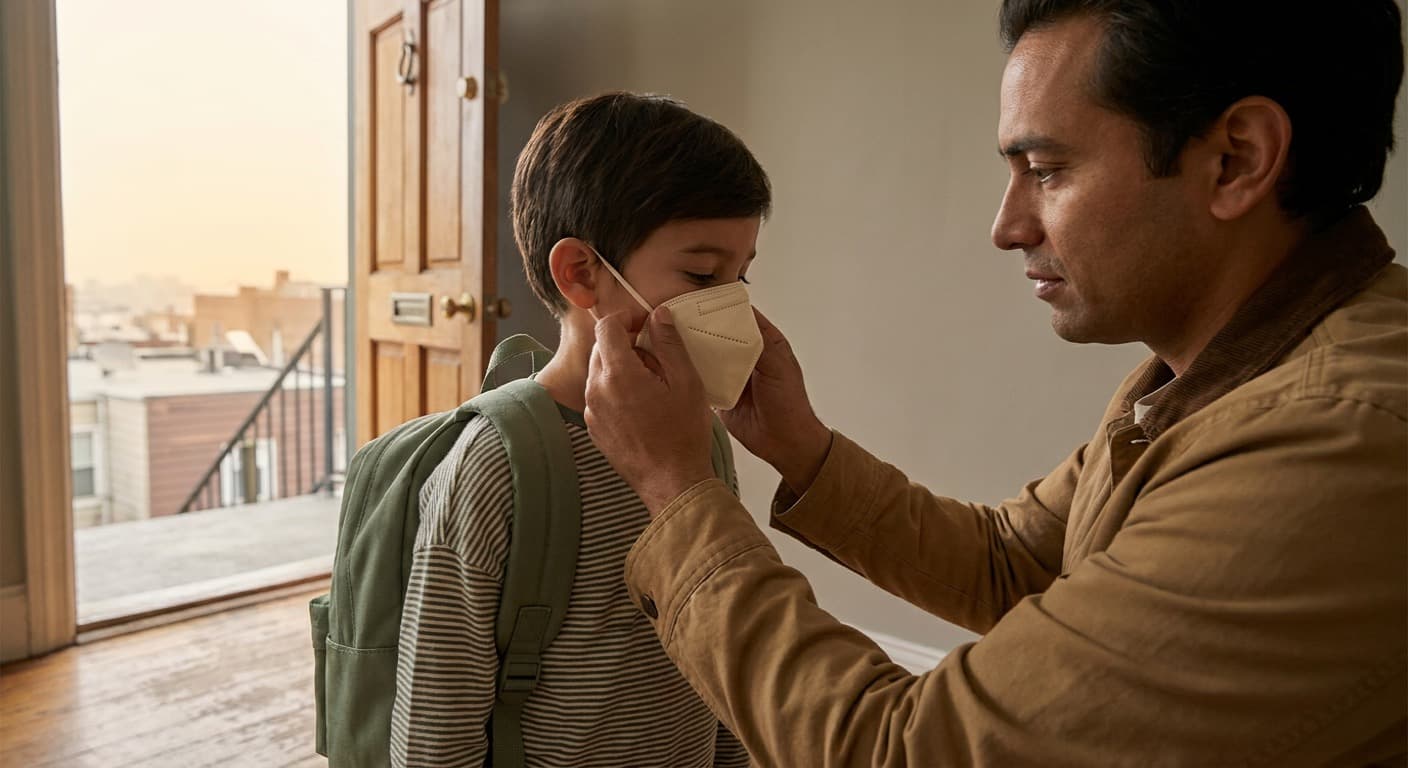
Why Age 7 Is the Dividing Line for Kids and Masks
EPA warns that respirators are not sized for young children — but pediatric environmental health specialists draw a practical line at age 7. Here is why fit fails on smaller faces, why older kids can often wear adult-small sizes, and what parents of younger children should do instead during wildfire smoke.