How Masks Are Tested: The Science Behind Certification Standards
From salt aerosol generators to breathing simulators — a behind-the-scenes look at how laboratories test masks for filtration, breathability, and real-world fit, with a side-by-side comparison of the N95, KN95, KF94, FFP2, and ASTM F3502-21 standards.
When a mask claims 95% or 99% filtration efficiency, what does that number actually mean? How was it tested? Under what conditions? And does the test bear any resemblance to how you actually breathe in real life? Understanding mask testing methodology is essential for evaluating whether a certification label translates into real protection. This deep dive takes you inside the testing labs, explains the equipment and protocols, and reveals why different standards produce such different results for seemingly similar products.
A mask can legitimately claim "95% filtration" under one testing protocol while delivering only 60% protection under another. The difference is not fraud. It is methodology. Some tests evaluate only the filter material, others test the whole mask. Some use resting breathing rates, others simulate heavy exertion. Understanding these differences is the key to reading certification labels accurately.
What Happens Inside a Mask Testing Lab?
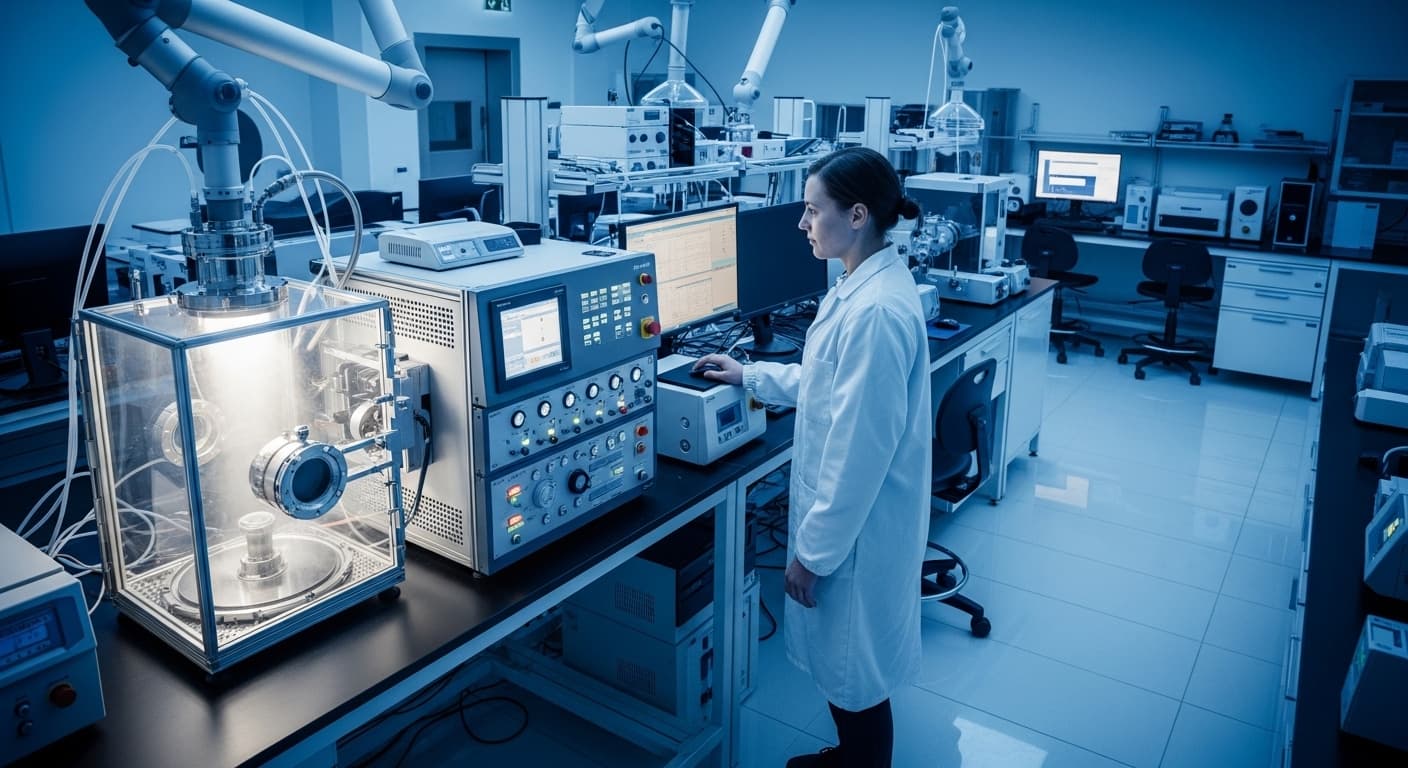
Mask testing labs are controlled environments where temperature, humidity, particle concentration, and airflow can be precisely regulated. The core equipment includes an aerosol generator (which produces test particles of known size and concentration), a breathing simulator (which replicates human breathing patterns at specified flow rates), a test chamber (which contains the mask specimen), and particle counters (which measure how many particles pass through the mask versus how many were presented to it). The ratio of downstream to upstream particle count gives the penetration percentage, and filtration efficiency is simply 100% minus penetration.
The 0.3 Micron Challenge: Most Penetrating Particle Size
You might assume that smaller particles are harder to filter. Intuitively, it makes sense — smaller particles should slip through filter gaps more easily. But filtration science is counterintuitive. The most difficult particle size to capture is actually around 0.3 microns (300 nanometers), known as the Most Penetrating Particle Size (MPPS). Particles smaller than 0.3 microns are captured efficiently through Brownian diffusion — their random zigzag motion causes them to contact and stick to filter fibers. Particles larger than 0.3 microns are captured through interception and inertial impaction — their momentum carries them into filter fibers. At 0.3 microns, neither mechanism dominates, creating a "valley" in filtration efficiency. This is why rigorous standards test at this exact size. If a mask filters 95% of 0.3-micron particles, it filters even more of both smaller and larger particles.
NaCl Aerosol Testing: The Gold Standard
The most widely recognized filtration test uses sodium chloride (NaCl) aerosol as the challenge agent. NaCl particles are generated at a median diameter of 0.075 microns (with a geometric standard deviation that produces a distribution centered around the MPPS), then directed at the mask at a specified flow rate. NIOSH uses 85 liters per minute for N95 testing — representing heavy physical exertion like construction work. This is important: the higher the flow rate, the more particles are pushed against the filter per unit time, and the more aggressively the mask's seal is stressed. A mask that performs well at 85 L/min provides a substantial performance margin during normal breathing (which typically ranges from 6-15 L/min at rest to 30-50 L/min during moderate exercise).
Breathing Simulators: How Labs Replicate Human Breathing
Human breathing is cyclical — inhale, pause, exhale, pause, with varying depths and rates. Testing labs use mechanical breathing simulators that replicate these patterns at standardized minute ventilation rates. The simulator creates negative pressure during the inhale phase (pulling air through the mask) and positive pressure during the exhale phase (pushing air outward). Advanced simulators can cycle between different breathing rates and depths to simulate real-world variability, including the deep breaths that occur during speech, coughing, and physical exertion. The exhale phase is particularly important for testing source control, how effectively the mask filters outgoing respiratory emissions.
Fit Testing: OSHA's 8-Exercise Protocol
Filtration testing evaluates the filter material. Fit testing evaluates the mask-face interface. OSHA's quantitative fit test (QNFT) protocol requires the test subject to perform eight specific exercises while wearing the mask inside a test chamber with a known ambient particle concentration. A probe inserted through the mask continuously samples the air inside, and the ratio of inside-to-outside particle concentration gives the fit factor. To pass, the mask must achieve a fit factor of at least 100, meaning the inside concentration is less than 1% of the outside concentration throughout all eight exercises.
- 1Normal breathing — standing still, breathing at resting rate for 60 seconds
- 2Deep breathing — slow, deep breaths for 60 seconds, testing seal under increased volume
- 3Head side to side — turning head fully left to right for 60 seconds, testing cheek seal
- 4Head up and down — nodding motion for 60 seconds, testing nose bridge and chin seal
- 5Talking — reading a standardized passage aloud for 60 seconds, testing seal during jaw movement
- 6Grimacing — extreme facial expressions for 15 seconds, stress-testing seal at maximum face movement
- 7Bending over — touching toes repeatedly for 60 seconds, testing seal under positional change
- 8Normal breathing (repeat) — final 60-second resting test to confirm no seal degradation from exercises
How Different Standards Compare
Not all mask standards test the same things, and understanding these differences is critical for evaluating protection claims. NIOSH N95 (USA) tests only the filter material at 85 L/min using NaCl aerosol — it says nothing about seal or fit. China's GB 2626-2019 (KN95) tests filter material at 85 L/min and adds a total-inward-leakage requirement (≤8%) plus an inhalation-resistance limit. South Korea's KF94, certified by the Ministry of Food and Drug Safety, requires ≥94% filtration against both NaCl and paraffin-oil aerosols and caps inward leakage at ≤11%. Europe's EN 149 (FFP2) tests filtration plus a fit test on human subjects (≤8% leakage). ASTM F3502-21 is the only one of the group written specifically for consumer masks: it evaluates sub-micron filtration efficiency, inhalation and exhalation resistance, and source control (outward leakage) on the complete product rather than the filter media alone.
| Standard (Region · Governing spec) | Min. filtration & test aerosol | Test flow rate | Whole-mask leakage / fit | Breathing-resistance limit | Source control tested? | Certifying body |
|---|---|---|---|---|---|---|
| N95 (USA · NIOSH 42 CFR 84) | ≥95% · NaCl (~0.3 µm MMAD) | 85 L/min | Not in filter approval (OSHA fit test is separate) | Inhale ≤343 Pa · exhale ≤245 Pa | No | NIOSH (US CDC) |
| KN95 (China · GB 2626-2019) | ≥95% · NaCl (& oil) | 85 L/min | Total inward leakage ≤8% | Inhale ≤350 Pa · exhale ≤250 Pa | No | Manufacturer self-declaration / accredited labs — no single gatekeeper |
| KF94 (South Korea · MFDS) | ≥94% · NaCl & paraffin oil | 95 L/min | Total inward leakage ≤11% | Inhale/exhale limits set by MFDS | No | Korea Ministry of Food & Drug Safety |
| FFP2 (EU · EN 149:2001+A1:2009) | ≥94% · NaCl & paraffin oil | 95 L/min | Total inward leakage ≤8% | Inhale ≤240 Pa (@95 L/min) | No | EU Notified Body |
| ASTM F3502-21 (USA · consumer) | Sub-micron: L1 ≥20% / L2 ≥50% (whole mask)† | Sub-micron NaCl | Non-mandatory qualitative leakage design analysis | L1 ≤15 mm H₂O · L2 ≤5 mm H₂O (≈≤49 Pa) | Yes (design analysis) | Manufacturer, tested to ASTM |
ASTM F3502's "≥20% / ≥50%" numbers are category *floors* for barrier face coverings, tested on the whole mask — they are not comparable to N95's 95% filter-material figure. A product can clear the F3502 Level 2 floor while filtering far more in practice. What F3502 uniquely adds versus N95, KN95, and KF94 is that it also caps breathing resistance and requires a source-control (outward-leakage) analysis on the finished mask, not just the media. AirPop Light SE is certified to ASTM F3502-21 by Intertek (Level 2 filtration efficiency, Level 1 air flow resistance) and measures >97% sub-micron filtration — clearing the floor by a wide margin while meeting the breathing-resistance and source-control criteria the respirator standards do not test. Breathing-resistance limits are shown in each standard's native units (35 mm H₂O ≈ 343 Pa).
We publish the full standards comparison above as a free, openly-licensed dataset (CC BY 4.0) for buyers, procurement teams, journalists, and researchers: CSV · JSON. The JSON includes per-standard source citations and the important caveat that the filtration column is not directly comparable across respirator and barrier-mask standards. Attribution: AirPop (getairpop.com).
When a mask claims "95% filtration," ask: tested at what flow rate? On the filter material alone, or on the complete mask? With what particle size? Under what standard? A mask that filters 95% of particles at 30 L/min on flat filter media may perform very differently at 85 L/min on a human face. ASTM F3502 addresses these gaps by testing complete mask performance, not just material performance.
Filter Loading and Degradation Testing
A fresh filter performs differently from one that has been breathed through for eight hours. Filter loading tests evaluate how performance changes as the filter accumulates particles over time. In NaCl loading tests, the filter is exposed to continuous aerosol at specified concentrations until a target loading mass (typically 200 mg) is reached, with filtration efficiency measured at intervals throughout. Interestingly, electrostatic filters (used in most high-efficiency masks, including AirPop) can show decreasing efficiency as the electrostatic charge is neutralized by particle loading and humidity. Mechanical filters show increasing efficiency as accumulated particles create a secondary filtration layer, but at the cost of significantly increased breathing resistance. Understanding these trade-offs is essential for determining real-world mask lifespan.
Temperature and Humidity Conditioning
Testing labs condition mask samples at controlled temperature (typically 38°C +/- 2.5°C) and relative humidity (85% +/- 5%) to simulate worst-case wearing conditions. High temperature and humidity accelerate the degradation of electrostatic charge in filter media, so conditioning reveals how the mask will perform under sustained use in warm, humid conditions — like wearing it for an extended commute on a summer day. Some standards require pre-conditioning before filtration testing, while others test at ambient conditions. This variation helps explain why the same mask can produce different filtration numbers under different standards.
AirPop products are certified to ASTM F3502-21 by Intertek, Level 2 for filtration efficiency and Level 1 for air flow resistance. The standard covers sub-micron NaCl aerosol filtration, breathing resistance limits, source control verification, and testing under conditions that simulate real-world wear. The 3D AeroDome structure is specifically engineered to maintain seal integrity through all eight OSHA fit test exercises. For what this certification means at the product level, see our ASTM F3502 overview — retail and institutional buyers can request full certification documentation through our wholesale program.
Related Article
Understanding Mask Certifications
A comprehensive overview of N95, KN95, KF94, FFP2, and ASTM F3502 certifications.
Related Article
ASTM F3502-21 Explained
Why the new ASTM standard represents a fundamental shift in how consumer masks are evaluated.
Related Article
KN95 vs N95 vs KF94: The Distributor's Guide
A side-by-side stocking checklist of the three global respirator standards — what to verify before you buy.
Related Article
ASTM F3502 vs N95 vs KN95
Which standard actually protects your customers — a head-to-head for retail buyers.
About the author
Chris HosmerCo-Founder, AirPop
Industrial designer and co-founder of AirPop. In 2015, while living in Shanghai, he invented AirPop's first smart mask after watching his own children struggle to breathe through the city's air pollution — creating the Air Wearables category. Leads product engineering, certification testing, and filtration technology development.
View Test Results
See AirPop's independently verified test data, standard by standard.
View Test ResultsRelated Articles
The Complete Guide to ASTM F3502-21: What This Certification Really Means
ASTM F3502-21 is the only US standard that tests both filtration AND fit for consumer masks. This guide explains what it measures, why other certifications fall short, and how to verify that your mask actually protects you.

The Science of Filtration: How AirPop Blocks >97% of Particles
Electrostatic capture, mechanical interception, and multi-layer media engineering — discover the science that allows AirPop masks to filter out >97% of airborne particles while remaining remarkably breathable.
ASTM F3502 vs N95 vs KN95: Which Standard Actually Protects Your Customers?
Three certifications, three different testing approaches, and vastly different real-world protection levels. This head-to-head comparison helps retail buyers choose the right standard for their assortment.