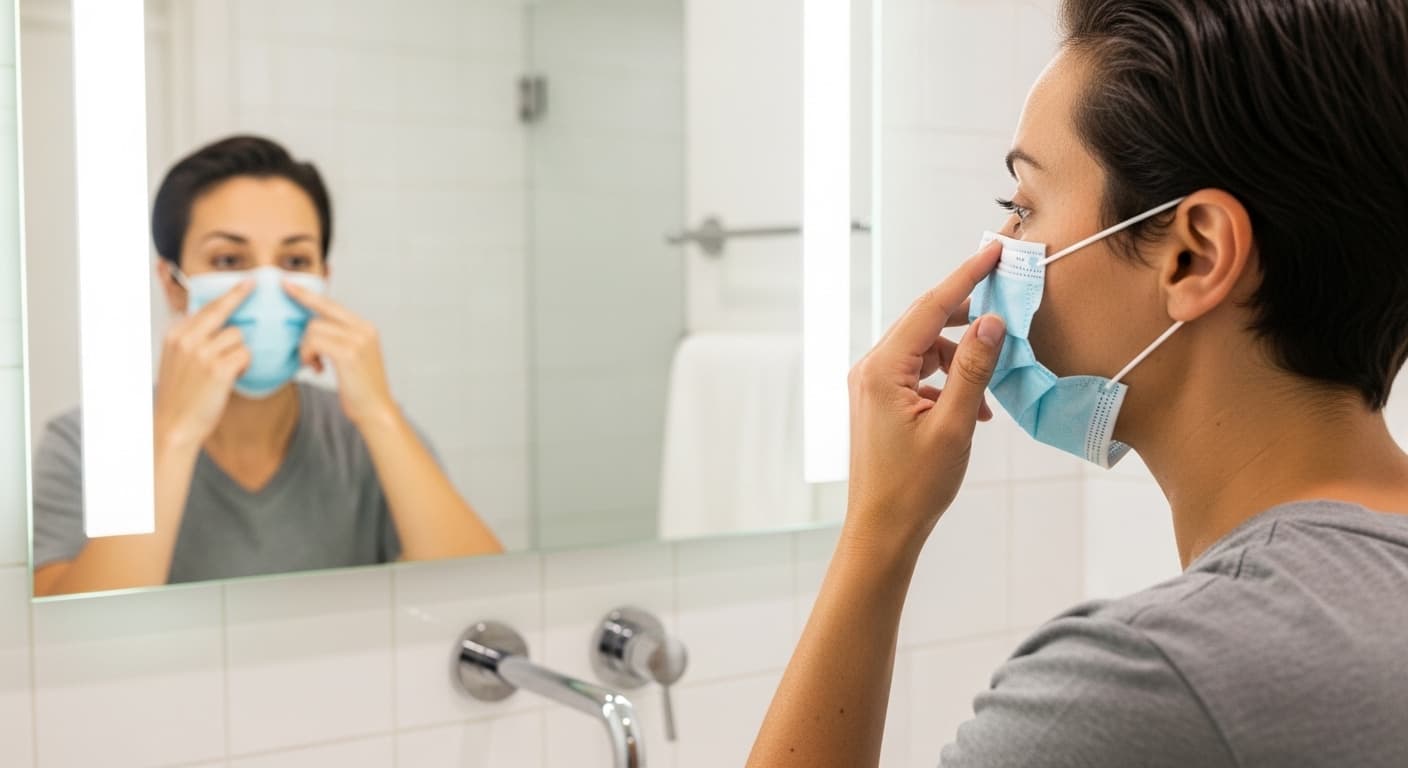
Mask Fit and Seal: How to Know If Your Mask Actually Protects You
A KN95 blocks 99.3% of particles as material and 83.9% once it is on a face. Three one-minute home tests tell you which side of that gap your mask is on.
You can tell whether a mask fits by exhaling hard and checking where the air goes: if it escapes at the nose, cheeks, or chin instead of passing through the fabric, the mask does not fit, regardless of what the filtration rating says. This matters more than most people expect. In testing published in PLOS ONE, KN95 filter material blocked 99.3% of particles on the bench — but the same masks let 16.1% of particles through once they were actually worn on a face. The filter did not get worse. The air went around it.
Why Does Seal Matter More Than Filtration?
Air follows the path of least resistance. If there is a gap between your mask and your face, even a millimeter-wide gap along the nose bridge or at the chin, a significant portion of each breath will flow through that gap rather than through the filter. The PLOS ONE study put numbers on this by measuring the same masks two ways — filtration of the material alone, then total inward leakage with the mask worn on a person. Procedure masks blocked 89.7% as material and 55.8% as worn. KN95s blocked 99.3% as material and 83.9% as worn. N95s, which are the only category in the study designed to seal, blocked 99.4% as worn. The authors state the conclusion plainly: mask fit with an effective face seal matters far more to protecting the wearer than the filtration efficiency of the material.
A 2024 JAMA Network Open study fit-tested 824 N95s worn by 412 emergency clinicians. After a single shift, 38.7% had already failed — and the failure rate split sharply by shape: 25.8% for dome respirators, 28.3% for duckbill, 61.3% for trifold. Every one of those masks met the same certification. The difference was the structure holding it against the face. Nothing about a failed seal feels different while you are wearing it, which is why you have to test rather than assume.
How Do You Tell If a Mask Fits Properly?
A mask fits properly when every breath you take has to go through the fabric, and there is no easier way to check that than to make the air prove it. Three tests do this, they take about a minute in total, and they check different failure points — which is why passing one is not the same as fitting well. The glasses test finds nose-bridge leaks. The hand check finds leaks anywhere around the perimeter, including the chin, which the glasses test cannot see. The candle test shows whether the mask is releasing air in a concentrated jet or spreading it across the whole surface. Run all three on a mask you already own before you trust it.
A properly fitting mask does four things: it fogs no glasses, it pushes outward against cupped hands when you exhale, it lets no warm air escape at the nose, cheeks, or chin, and it stays put when you talk and turn your head. If any one of those fails, the mask is not fitting — adjust the nose wire and straps and retest. If it still fails after adjustment, the problem is the mask shape against your face, not your technique.
Home Test #1: The Glasses Fog Test
This is the simplest and most widely accessible seal test. Put on your mask, then put on glasses or sunglasses (or hold a small mirror close to your face above the nose bridge). Breathe normally through your nose for 30 seconds. If your glasses fog, air is escaping upward through the nose bridge, the most common seal failure point. A properly sealed mask should produce zero fogging because all exhaled air passes through the filter, not around it.
- 1Put on your mask and adjust all straps and the nose wire
- 2Put on glasses or hold a small mirror 1 inch above the nose bridge
- 3Breathe normally through your nose for 30 seconds
- 4Check for any fogging on the lenses, even slight fogging indicates a seal gap
- 5If fogging occurs, re-mold the nose wire and repeat — persistent fogging means the mask does not fit your face geometry
Home Test #2: The Hand Check Method
Cup both hands gently over the front of your mask without pressing the mask against your face. Exhale forcefully. You should feel the mask push outward against your hands as it pressurizes. Now pay attention to your cheeks, chin, and nose bridge — can you feel warm air escaping along any edge? Move your hands slowly around the perimeter of the mask while continuing to exhale. Any point where you feel air escaping is a seal failure. This test is particularly good at detecting chin leaks, which the glasses test misses.
Home Test #3: The Candle Test
Light a candle and hold it 6 inches in front of your masked face. Exhale with moderate force. If the candle flame flickers significantly, air is passing through or around the mask with enough velocity to suggest poor filtration or seal. A well-sealed mask with good filtration should produce minimal flame movement because exhaled air is both filtered (reducing velocity) and distributed across the entire mask surface (reducing concentrated airflow). Note: this test primarily checks outward seal — use it in combination with the glasses and hand tests for a complete picture.
For the most thorough home assessment, perform all three tests in sequence: glasses fog test (checks nose bridge), hand check (checks full perimeter), candle test (checks overall outward seal). If your mask passes all three, you have a good real-world seal. If it fails any one test, consider a different mask design or size.
Why Flat Masks Fail the Seal Test
Flat-fold and surgical-style masks face a fundamental geometric problem: they are two-dimensional objects trying to seal against a three-dimensional face. The human face has complex contours, the nose bridge creates a sharp ridge, the cheeks curve outward, and the chin drops away at varying angles. A flat piece of material can only approximate these curves, leaving gaps at every transition point. This is why flat masks almost universally fail the glasses fog test and why OSHA requires rigid, contoured respirators for workplace protection.
How 3D Structure Solves the Seal Problem
Three-dimensional mask structures — like the AirPop AeroDome — are engineered to match facial contours rather than fight against them. By building the mask with pre-formed curvature at the nose, cheeks, and chin, a 3D mask holds its own shape instead of relying on tension to pull flat material into a curve, which is what keeps contact pressure consistent around the perimeter. The JAMA data is the clearest outside evidence that this is the variable that matters: dome-shaped respirators failed at 25.8% and trifolds at 61.3% in the same study, under the same certification, tested the same way. Shape was the difference. Worth being precise about what that does and does not prove — those were N95s, not AirPop masks, and ASTM F3502-21 does not include a fit-test requirement, so no certification on any consumer mask is a statement about how it seals on your particular face. That is what the home tests above are for.
The AirPop Light SE's 3D AeroDome structure is specifically engineered for seal integrity across diverse facial geometries. The dual-strap adjustment system allows independent upper and lower tension control, enabling users to achieve a personalized seal that flat-fold masks with single ear loops or headbands cannot match.
When to Replace Your Mask for Seal Reasons
Seal degradation happens gradually: nose wires lose their shape memory after repeated bending, elastic straps stretch with use, and structural elements fatigue over time. If a mask that previously passed your home tests starts failing them, it is time to replace it regardless of the filter's remaining life. Most single-use masks should be replaced after 8-10 hours of cumulative wear or immediately if the structure becomes visibly deformed. A mask with a perfect filter and a failing seal is not protecting you — replace proactively, not reactively.
Related Article
Complete Guide to ASTM F3502-21
The only US standard that tests both filtration and real-world fit for consumer masks.
Related Article
How to Choose the Right AirPop Mask
Find the right AirPop model for your face shape, activity level, and protection needs.
About the author
Chris HosmerCo-Founder, AirPop
Industrial designer and co-founder of AirPop. In 2015, while living in Shanghai, he invented AirPop's first smart mask after watching his own children struggle to breathe through the city's air pollution — creating the Air Wearables category. Leads product engineering, certification testing, and filtration technology development.
Related Articles
Why Your Glasses Fog With a Mask On (And What It Tells You)
Fogged glasses are not a glasses problem — they are evidence that warm breath is escaping through a gap at your nose bridge, which is the same gap letting unfiltered air in. Here is why the nose bridge fails on most masks, what the popular fixes actually do, and why anti-fog spray is the worst of them.

Running in Cold Weather With a Mask: What Actually Happens
Cold-weather running creates one specific problem for masks, and everything else follows from it: condensation. Warm saturated breath meets fabric sitting at outdoor temperature, the vapour condenses, and unlike in summer it does not evaporate between breaths. A wet mask breathes harder and filters worse — one of which you notice immediately, one of which you never notice at all. Here is the physics, and what to look for.

How Long Does a KN95 Mask Last? What Actually Wears Out
There is no expiry date on a KN95, and a depleted mask looks identical to a new one. What wears out is the electrostatic charge in the filter media, the seal against your face, and the straps — three things that fail at different rates. Here is what degrades, what certifications do not cover, and when to replace it.