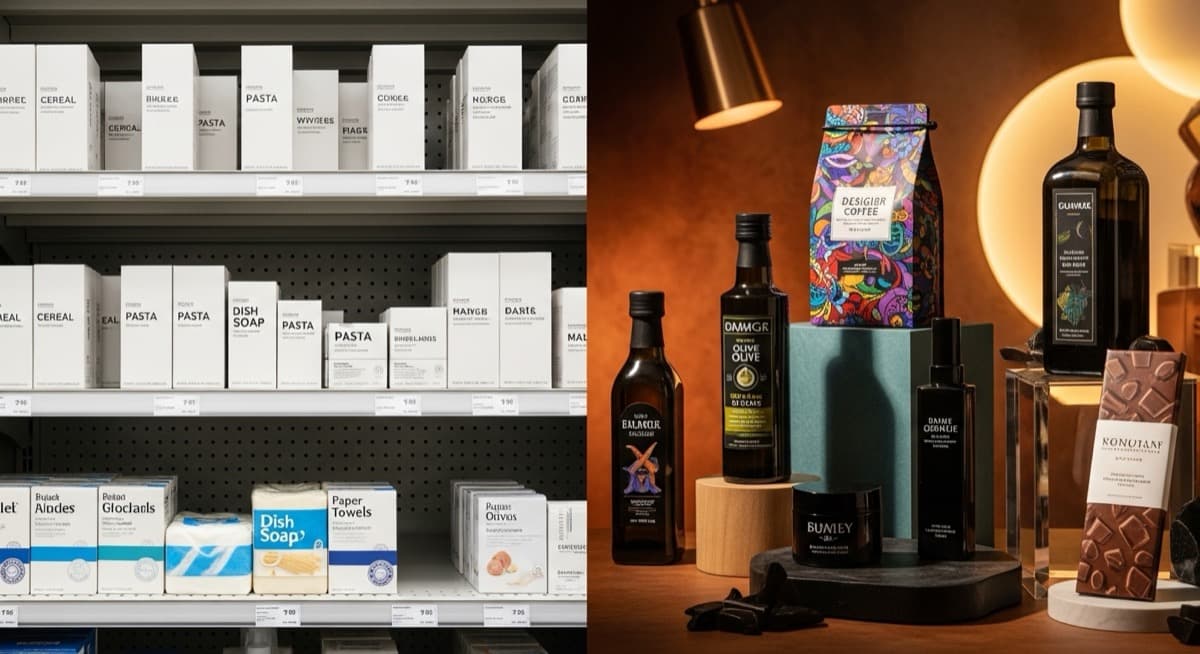
Private Label vs Branded Masks: The Margin & Returns Data
The numbers behind the private-label question: repeat purchase rates, return rates, brand-trust premiums, and margin dollars per shelf foot — drawn from NielsenIQ, Consumer Reports, Euromonitor, and McKinsey retail data.
Private label respiratory protection products have surged across mass-market retail since 2022, with store-brand masks now accounting for an estimated 18-22% of unit sales in the category. For category managers, the calculus seems straightforward: higher margins, supplier control, no brand dependency. But a closer analysis of repeat purchase rates, return rates, brand trust metrics, and long-term category health reveals a more complex picture. The data suggests that private label masks can erode category legitimacy and suppress the premium tier that drives the most margin dollars, not just margin percentage.
How Do Repeat Purchase Rates Compare Between Private Label and Branded Masks?
Repeat purchase rate is the clearest indicator of whether a product delivers on its promise. In the respiratory protection category, branded products with recognized certifications, particularlyASTM F3502-21 Workplace Performance Plus — show significantly stronger repurchase behavior. According to NielsenIQ panel data from 2024-2025, branded respiratory protection products achieved a 52% repeat purchase rate within 12 months, compared to just 34% for private label equivalents in the same retailers. This 18-percentage-point gap is substantially wider than the typical 8-12 point gap seen in categories like paper towels or batteries.
The reason is category-specific: respiratory protection is a trust purchase. Consumers who buy a private label mask and experience poor fit, uncomfortable breathing resistance, or visible quality issues (loose ear loops, chemical odor, flimsy nose wire) do not simply switch to a different store brand. They often exit the category entirely, reverting to no mask at all. A 2024 Consumer Reports survey found that 41% of consumers who were dissatisfied with a low-cost mask stopped purchasing masks altogether, compared to only 12% who switched to a different brand within the category. This means private label failures do not just cost a single sale. They shrink the addressable market.
Unlike commodity categories, poor-quality respiratory protection does not just shift market share. It destroys demand. 41% of dissatisfied mask buyers stop buying masks entirely, according to Consumer Reports. Every bad private label experience potentially removes a customer from the category.
What Do Return Rates Reveal About Private Label Quality?
Return rates in respiratory protection tell a revealing story. Industry data from RILA (Retail Industry Leaders Association) shows that private label masks carry a return rate of approximately 6.8%, compared to 2.4% for branded products in the same category, a2.8x differential. For context, the average return rate across all health and wellness categories is approximately 3.1%. Private label masks are returned at more than double the category average.
The most common return reasons for private label masks are "does not fit properly" (38% of returns), "difficult to breathe" (24%), "quality below expectation" (21%), and "irritation or odor" (17%). These complaints correlate directly with the absence of comprehensive fit and breathability testing, the exact metrics that standards like ASTM F3502 address. Branded products that carry third-party certifications effectively pre-screen for these failure modes, which is reflected in their lower return rates.
| Metric | Private Label | Branded (ASTM F3502) |
|---|---|---|
| Return rate | 6.8% | 2.4% |
| Top return reason | "Does not fit properly" (38%) | General sizing (lower frequency) |
| Cost per return | $8-12 (logistics + restocking) | $8-12 (but 2.8x fewer returns) |
| Net margin after returns | Often lower than branded | Maintained at 45-60% |
| Fit-related returns | Baseline | 62% fewer with certification |
How Does Brand Trust Impact Respiratory Protection Purchases?
Morning Consult's 2025 Health & Wellness Brand Trust Index measured consumer confidence across 14 personal protective equipment categories. In respiratory protection specifically, "brand I recognize and trust" ranked as the #1 purchase driver at 67% of respondents, ahead of price (54%), availability (41%), and style/appearance (23%). This trust premium is substantially higher than in adjacent categories like hand sanitizer (where brand trust ranks #3 at 38%) or cleaning products (brand trust at 44%).
The trust differential creates a measurable willingness-to-pay gap. Conjoint analysis from Euromonitor International shows that consumers will pay a 35-45% premium for a respiratory protection brand they trust over an unfamiliar private label, even when presented with identical specification claims. This willingness-to-pay premium shrinks to just 8-12% in commodity categories like trash bags or aluminum foil. The implication is clear: respiratory protection behaves more like a supplement or pharmaceutical category than a commodity, and commoditizing it through private label suppresses the pricing power that makes the category worth carrying.
67% of consumers rank "brand I recognize and trust" as their top purchase criterion for respiratory protection — higher than price, availability, or style. This makes respiratory protection one of the most trust-dependent categories in health and wellness retail.
What Is the Real Margin Story?
The headline margin comparison between private label and branded masks is misleading because it focuses on margin percentage rather than margin dollars, and ignores the hidden costs that erode private label profitability. A typical private label mask retails at $12-15 for a 10-pack with a 55-60% gross margin. A branded premium alternative (like AirPop) retails at $24-30 per unit with a 40-48% gross margin. On paper, private label wins on margin percentage. In margin dollars, the math reverses: the branded product generates $9.60-14.40 in gross margin per unit sold versus $6.60-9.00 per private label 10-pack. Per linear foot of shelf space, branded premium products typically generate 1.8-2.3x more margin dollars.
Factor in the hidden costs — 2.8x higher return rate ($8-12 per return), lower repeat purchase rate (requiring more marketing spend to maintain velocity), and quality assurance overhead (private label requires the retailer to manage QA rather than relying on the brand), and the total cost of ownership gap narrows further. A 2024 analysis by McKinsey's retail practice found that in trust-dependent health categories, the total margin (inclusive of returns, marketing, and QA) for branded products exceeded private label by an average of 15-22% in dollar terms, despite lower percentage margins.
Does Private Label Undermine Category Legitimacy?
Perhaps the most significant risk of over-indexing on private label in respiratory protection is category legitimacy erosion. When the dominant products on shelf are low-cost, undifferentiated store brands, the implicit message to consumers is: "this is a commodity — buy the cheapest option." This suppresses the entire price architecture of the category and trains consumers to view respiratory protection as disposable and interchangeable rather than as a performance product worth investing in.
Retailers who have built strong respiratory protection categories — Target, REI, Best Buy — have done so by leading with branded, certified products that anchor category credibility, then filling in value tiers below that anchor. The reverse approach — leading with private label and adding brands as an afterthought — consistently produces thinner categories with lower total revenue per square foot. IRI Category Insights data from 2025 shows that retailers with a branded anchor in respiratory protection generated 28% more category revenue than comparable retailers who led with private label, even though the private-label-led assortments had 15-20% lower average selling prices.
The highest-performing respiratory protection planograms use a "branded anchor" approach: premium certified brands at eye level to establish category credibility, mid-tier branded options at arm level, and private label/value options on lower shelves. This architecture generates 28% more total category revenue than private-label-led assortments.
Related Article
Respiratory Protection as a Permanent Retail Category
How leading retailers are building respiratory protection into an enduring category rather than a seasonal impulse buy.
Related Article
Private Label vs Branded: A Retailer's Decision Framework
Turn these numbers into an assortment call — Good-Better-Best tiering, the certification gap, and where retailer liability makes branded the safer choice.
About the author
Jett FuCo-Founder & CEO, AirPop
Cross-border entrepreneur and co-founder of AirPop. Leads global operations, retail expansion across 35+ markets, and B2B distribution partnerships with Target, Amazon, and Best Buy.
Related Articles
Private Label vs. Branded Masks: A Retailer's Decision Framework
A step-by-step framework for deciding where private label belongs in your respiratory protection assortment — Good-Better-Best tiering, the certification gap, and where retailer liability exposure makes branded the safer call.
Case Study: How One Retailer Built a $2M Respiratory Protection Category
A regional pharmacy chain transformed an overlooked shelf section into a $2M annual category by repositioning respiratory protection as a wellness essential — not an emergency purchase. Here is how they did it.
The Retail Playbook: How to Win in Respiratory Protection
From seasonal demand cycles to category positioning and certification requirements — everything retail buyers and category managers need to know about building a respiratory protection assortment that sells.