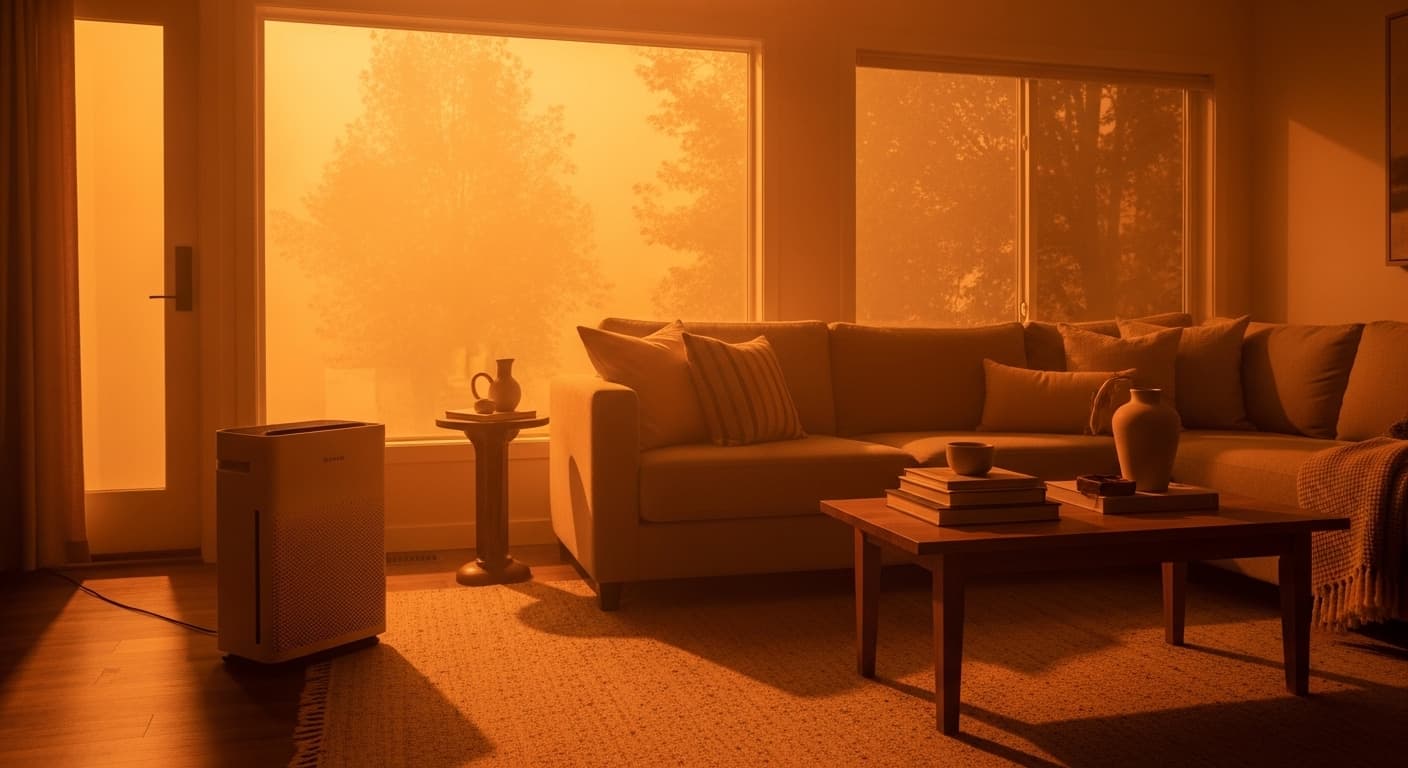
Wildfire Smoke Indoors: How to Protect Your Home When the AQI Spikes
Indoor PM2.5 can reach 50-70% of outdoor levels during wildfire smoke events without mitigation. Sealing your home, upgrading HVAC filters to MERV 13+, and running HEPA purifiers can reduce indoor smoke exposure by 60-80%. Here is the complete layered protection strategy.
When wildfire smoke rolls in, the universal advice is simple: stay indoors. But for millions of people across North America, staying indoors does not actually mean staying safe. Without active mitigation, PM2.5 concentrations inside your home can reach 50 to 70 percent of outdoor levels during a smoke event, according to the EPA. Your walls, windows, and doors slow the infiltration — they do not stop it. Protecting your indoor air during wildfire season requires a deliberate, layered strategy: sealing your building envelope, filtering recirculated air, running standalone purifiers, and knowing when respiratory protection is still necessary even inside your own home.
Enter your ZIP code in our free air quality tool to see the live AQI near you, pulled from EPA AirNow, with plain-language guidance for children, sensitive groups, and outdoor workers.
EPA research shows that during wildfire smoke events, indoor PM2.5 can reach 50-70% of outdoor concentrations in homes without mitigation. A home near a wildfire zone with outdoor AQI of 300 (Hazardous) can have indoor PM2.5 equivalent to AQI 150-210 (Unhealthy to Very Unhealthy) — well above levels that cause respiratory harm, especially for children, elderly, and people with asthma or heart disease.
Why Does Wildfire Smoke Get Inside Your Home?
Wildfire smoke particles are extraordinarily small. The most harmful fraction — PM2.5 and ultrafine particles below 0.1 micrometers — behaves more like a gas than a solid. These particles infiltrate through every imperfection in your building envelope: gaps around windows and doors, unsealed electrical outlets, plumbing penetrations, dryer vents, bathroom exhaust ducts, and the joints between walls and foundations. Even in relatively well-sealed modern construction, the natural air exchange rate means your entire indoor air volume is replaced every few hours. In older homes with single-pane windows, visible door gaps, and uninsulated attics, infiltration happens faster.
Your HVAC system is another major entry point. Central air conditioning and forced-air heating systems pull outdoor air through return ducts, intake vents, and the unit itself. If your system uses a standard MERV 6 or MERV 8 filter — the type pre-installed in most residential systems — it captures less than 20 percent of PM2.5 particles. The system is effectively pumping filtered-but-still-smoky air throughout every room in your house.
How Do You Seal Your Home Against Wildfire Smoke?
Sealing is the first and cheapest layer of protection. You cannot filter what you can prevent from entering in the first place. The goal is not to make your home airtight — that would create CO2 and humidity problems — but to reduce the infiltration rate enough that your filtration systems can keep up. Focus on the highest-leakage points first.
- 1Close all windows and exterior doors. This sounds obvious, but it includes garage doors, pet doors, and any windows left cracked for ventilation.
- 2Apply weatherstripping to doors and windows with visible gaps. Self-adhesive foam or V-strip weatherstripping is available at any hardware store for under $10 per door.
- 3Install door sweeps on exterior doors — the gap between the bottom of a door and the threshold is one of the largest single infiltration points in most homes.
- 4Seal around window-mounted air conditioning units with foam board and tape. These units are designed to ventilate, which is the opposite of what you want during a smoke event.
- 5Close fireplace dampers completely. An open chimney is a direct conduit for outdoor air.
- 6Cover bathroom exhaust fans and kitchen range hoods when not in use — these create negative pressure that pulls outdoor air in through other gaps.
- 7Use painter's tape or plastic sheeting to temporarily seal any visible gaps around attic hatches, recessed lights, or electrical outlets on exterior walls.
Running exhaust fans, dryers, or fireplaces creates negative pressure inside your home, actively pulling smoky outdoor air in through every gap. During smoke events, minimize the use of anything that exhausts indoor air. If you must use your kitchen range hood, open a single window with a box fan and MERV 13 filter attached (see Corsi-Rosenthal box below) to provide controlled, filtered makeup air.
Should You Upgrade Your HVAC Filter?
Yes — and it is one of the most effective single changes you can make. The EPA recommends upgrading to a MERV 13 or higher filter for residential HVAC systems during wildfire events. A MERV 13 filter captures approximately 85 percent or more of PM2.5 particles, compared to less than 20 percent for the MERV 6-8 filters that come standard in most systems. MERV 16 filters, where compatible, capture over 95 percent.
There is an important caveat: not all HVAC systems can handle high-MERV filters. Denser filter media increases static pressure, which can reduce airflow and strain your blower motor. Before upgrading, check your system's maximum rated filter MERV or consult your HVAC manufacturer. Most systems built after 2010 can handle MERV 13 without issues. Older systems may need to stay at MERV 11 or use a deeper filter cabinet (4-inch instead of 1-inch) to achieve higher filtration without excessive pressure drop.
MERV 6-8 (standard residential): captures less than 20% of PM2.5. MERV 11: captures approximately 65% of PM2.5. MERV 13 (EPA recommended minimum for smoke): captures approximately 85%+ of PM2.5. MERV 16: captures over 95% of PM2.5. Higher is better for smoke events, but verify your HVAC system compatibility before upgrading.
During active smoke events, set your HVAC system to run the fan continuously rather than on the auto setting. Auto mode only runs the fan during heating or cooling cycles, meaning your air goes unfiltered between cycles. Continuous fan mode pushes all your indoor air through the filter repeatedly, steadily reducing PM2.5 concentrations even when the system is not actively heating or cooling.
Do Portable HEPA Air Purifiers Actually Work for Wildfire Smoke?
Portable HEPA air purifiers are the single most effective intervention for reducing indoor PM2.5 during wildfire smoke events. True HEPA filters capture 99.97 percent of particles at 0.3 micrometers — the most penetrating particle size — making them significantly more effective than even the best HVAC filters. Studies conducted during California wildfire seasons, including research from the California Air Resources Board, have documented 60 to 80 percent reductions in indoor PM2.5 when properly sized HEPA purifiers are used in closed rooms.
The key phrase is "properly sized." A purifier that is too small for the room will run at full speed and still not keep up with infiltration. The metric that matters is Clean Air Delivery Rate, or CADR, measured in cubic feet per minute (CFM). The Association of Home Appliance Manufacturers (AHAM) recommends selecting a purifier with a smoke CADR of at least two-thirds of your room's square footage. For a 200-square-foot bedroom, you need a minimum smoke CADR of 133. For a 350-square-foot living room, you need at least 233.
| Room Size (sq ft) | Minimum Smoke CADR | Example Rooms |
|---|---|---|
| 150 | 100 CFM | Small bedroom, home office |
| 200 | 133 CFM | Standard bedroom |
| 300 | 200 CFM | Large bedroom, small living room |
| 400 | 267 CFM | Living room, open kitchen |
| 500+ | 333+ CFM | Great room, open floor plan — consider two units |
- Look for purifiers with true HEPA filters (not "HEPA-type" or "HEPA-style" which have lower filtration)
- Check the smoke CADR specifically — it is often lower than the dust or pollen CADR on the same unit
- Avoid purifiers that rely on ionization, UV, or ozone generation as their primary mechanism — these are ineffective against PM2.5 and some produce harmful byproducts
- Place purifiers in the rooms where you spend the most time, especially bedrooms for overnight protection
- Close doors to create defined zones that the purifier can effectively clean
- Run on the highest tolerable speed setting — noise is the tradeoff for faster air cleaning
What Is a Corsi-Rosenthal Box and Does It Work?
If a quality HEPA purifier is not in your budget, a Corsi-Rosenthal box is a proven, research-backed alternative. Named after Dr. Richard Corsi (then at Portland State University, now Dean of Engineering at UC Davis) and Jim Rosenthal of Tex-Air Filters, this DIY device uses four or five MERV 13 furnace filters taped together in a cube shape with a standard box fan on top. The total cost is typically $50-80 in materials.
Peer-reviewed research published in the journal Science and Technology for the Built Environment confirmed that properly constructed Corsi-Rosenthal boxes achieve CADR ratings comparable to commercial purifiers costing $200-400, with PM2.5 reduction of 40-60 percent in typical room sizes. During the 2020 and 2021 wildfire seasons, public health departments across Oregon, Washington, and California distributed assembly instructions and funded community build events. It is not as quiet or aesthetically refined as a commercial HEPA purifier, but the filtration performance is real and well-documented.
- 1Buy four or five MERV 13 filters (20x20 inch) and one 20-inch box fan
- 2Tape the filters together into a cube using the fan as the top face, with airflow direction arrows pointing inward
- 3Seal all seams with duct tape to prevent bypass
- 4Add a cardboard base to close the bottom of the cube
- 5Run the fan on medium or high — the large filter surface area keeps pressure drop and noise manageable
How Do You Monitor Indoor Air Quality During Smoke Events?
You cannot manage what you cannot measure. The official AQI readings from monitoring stations like AirNow report outdoor conditions, but they tell you nothing about what is happening inside your home. A low-cost PM2.5 monitor — devices like the PurpleAir sensor, Temtop, or IQAir AirVisual — can give you real-time feedback on whether your sealing and filtration efforts are working. Prices range from $50 to $250, and the investment pays for itself in actionable data.
- AirNow.gov and the AirNow app — official EPA outdoor AQI data, updated hourly
- PurpleAir map — real-time, hyperlocal outdoor readings from community sensors; more granular than AirNow in many areas
- IQAir app — global AQI data with forecasting
- Indoor PM2.5 monitors (PurpleAir Indoor, Temtop M10, IQAir AirVisual) — essential for verifying your mitigation is actually working
- Smart home integration — some monitors can trigger HVAC or purifier automation when PM2.5 exceeds thresholds
The EPA considers PM2.5 levels below 12 micrograms per cubic meter (μg/m³) to be "Good" on the AQI scale. During smoke events, aim to keep your indoor PM2.5 below 35 μg/m³ (the "Moderate" threshold). If your indoor monitor reads above 55 μg/m³ ("Unhealthy for Sensitive Groups"), your sealing and filtration are not keeping up — time to escalate your mitigation or add a purifier to critical rooms.
When Do You Still Need Respiratory Protection Indoors?
Even with sealing and filtration, there are situations where indoor air quality deteriorates beyond what passive systems can handle. If outdoor AQI exceeds 300 (Hazardous), you live in an older home with high infiltration, or your indoor PM2.5 monitor consistently reads above 55 μg/m³ despite mitigation, wearing respiratory protection indoors is a rational precaution — especially for high-risk individuals. This is also true during the first few hours of a sudden smoke event, before your filtration systems have had time to bring indoor levels down.
And when you must venture outside during a smoke event — to commute, walk pets, check on neighbors, or evacuate — proper respiratory protection becomes essential. Standard cloth masks and surgical masks provide virtually no protection against wildfire PM2.5. You need a mask with certified sub-micron filtration of 95 percent or higher and an effective facial seal. Look for certifications including ASTM F3502-21, NIOSH N95, KN95, or KF94.
When you need to step outside during a smoke event — or when indoor levels exceed safe thresholds — AirPop masks filter more than 97% of sub-micron particles with low breathing resistance designed for extended wear. The 3D knit structure maintains a superior facial seal compared to flat-fold disposables, and the replaceable filter system means one mask lasts an entire wildfire season. Certified to ASTM F3502-21 (Intertek).
What About Children, Elderly, and Pets?
Wildfire smoke affects vulnerable populations disproportionately. Children breathe faster relative to body weight, have developing lungs, and are more likely to be physically active — increasing their PM2.5 dose per kilogram. The American Academy of Pediatrics recommends keeping children indoors with air filtration running during any smoke event where outdoor AQI exceeds 100. Adults over 65 are at elevated risk for cardiovascular events triggered by PM2.5 exposure, even at moderate concentrations. People with pre-existing asthma, COPD, or heart disease may experience symptom exacerbation at indoor PM2.5 levels that would not affect healthy adults.
Pets are often overlooked but face similar respiratory risks. Dogs and cats have smaller lungs and higher resting respiratory rates than humans. Birds are especially sensitive to airborne particulates and can die from smoke exposure that humans tolerate. During smoke events, keep pets indoors, avoid outdoor exercise for dogs, and place bird cages in purified rooms away from windows and exterior walls. If your pet shows labored breathing, excessive coughing, or nasal discharge, contact your veterinarian.
What Is the Complete Indoor Protection Checklist?
- Close all windows, exterior doors, pet doors, and garage doors
- Seal visible gaps with weatherstripping, door sweeps, and painter's tape
- Close fireplace dampers and cover bathroom exhaust fans
- Upgrade HVAC filter to MERV 13 or higher (verify system compatibility)
- Set HVAC fan to run continuously, not auto
- Run HEPA purifiers in bedrooms and main living areas (sized by CADR for room square footage)
- Monitor indoor PM2.5 with a sensor — target below 35 μg/m³
- Keep respiratory protection ready for trips outside or if indoor levels spike above 55 μg/m³
- Avoid activities that add to indoor air pollution: cooking on gas stoves, burning candles, vacuuming without HEPA filtration, or smoking
- Create a designated clean room — one small, well-sealed room with a HEPA purifier as a last-resort refuge if whole-home mitigation fails
- Stock HVAC filters and purifier replacement filters before wildfire season starts — supply chains strain during active smoke events
Related Article
Best Masks for Wildfire Smoke in 2026
How to choose respiratory protection that actually works against wildfire PM2.5 — certifications, features, and red flags to avoid.
Related Article
AQI Explained
What the Air Quality Index means, how to read it, and what each level means for your health and outdoor activity.
Related Article
Understanding PM2.5
The science behind fine particulate matter — why particles smaller than 2.5 micrometers are the most dangerous air pollutant for human health.
About the author
Jett FuCo-Founder & CEO, AirPop
Cross-border entrepreneur and co-founder of AirPop. Leads global operations, retail expansion across 20+ countries, and B2B distribution partnerships that have included Target, Amazon, and Best Buy.
See AirPop Filtration
>97% particle filtration when you need to step outside during smoke events.
See AirPop FiltrationRelated Articles
2026 Wildfire Season Forecast: What NIFC Predictions Mean for Your Health
NIFC forecasts above-normal wildfire potential across the Southwest, Great Basin, California, and southern Plains for summer 2026. With 1.6 million acres already burned and 50% of the U.S. in drought, here is what the predictions mean for respiratory health and how to prepare.
Wildfire Season 2026: Why Respiratory Protection Matters More Than Ever
With wildfire seasons growing longer and more intense, understanding PM2.5 protection has never been more important. Here's what you need to know.
Wildfire Preparedness for Schools and Organizations: A Bulk Protection Planning Guide
With 7.4 million U.S. children exposed to wildfire smoke annually, schools and organizations need proactive respiratory protection plans. This guide covers AQI trigger protocols, inventory planning, and bulk procurement strategies for institutional buyers.